
The Role of SMART Goals in Fitness: A Practical Guide to Lasting Progress
Starting a fitness journey often feels exciting. Motivation may be high, new workout clothes may be ready, and the desire to improve can make almost any plan feel possible. The real challenge usually appears several weeks later, when work becomes busy, progress slows, or the original enthusiasm begins to fade. At that point, a vague intention such as “get fit” may not provide enough direction to keep going.
The role of SMART goals in fitness is to turn that intention into a clear, organized, and realistic action plan. Instead of focusing only on a distant result, the SMART framework encourages people to identify specific behaviors, measurable milestones, realistic expectations, personal reasons, and an appropriate time frame. This makes fitness progress easier to plan and evaluate.
Goal setting is widely used in health, exercise, education, business, and personal development because it can improve focus and help people prioritize actions. Research on physical-activity interventions has also shown that structured goal setting can support improvements in exercise behavior, particularly when it is combined with self-monitoring, feedback, and practical planning.
However, a SMART goal is not a guarantee of success. A well-written goal can still fail when it ignores health limitations, recovery, enjoyment, available time, or personal preferences. Effective fitness goal setting therefore requires both structure and flexibility. The goal should guide a person toward meaningful progress without creating unnecessary pressure, guilt, or unsafe expectations.
This guide explains what SMART fitness goals mean, why they matter, how to write them, and how to adjust them when circumstances change. It also explores common mistakes and shows how process, performance, and outcome goals can work together to support long-term fitness success.
What Do SMART Goals Mean in Fitness?
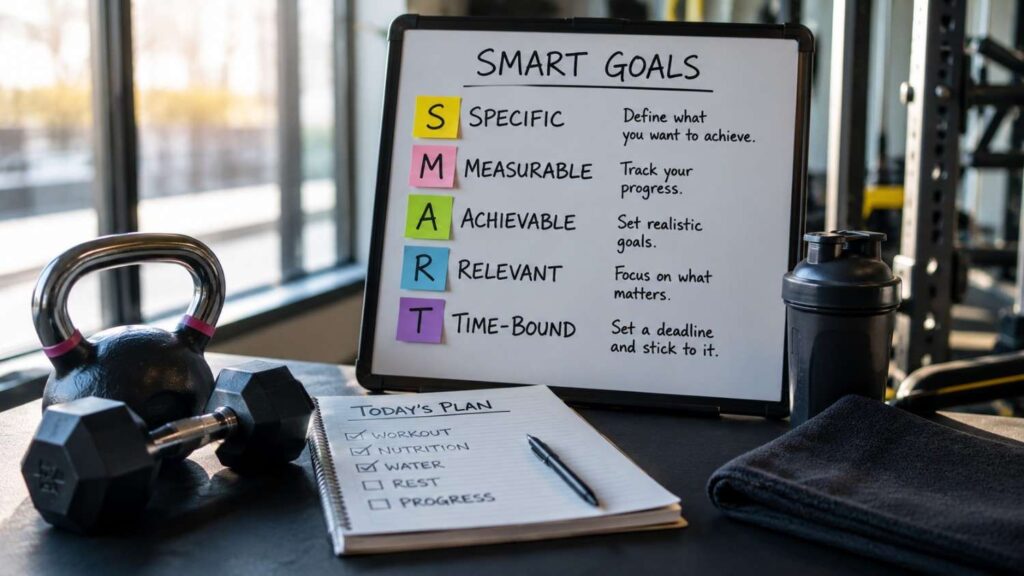
SMART fitness goals provide a structured method for planning exercise and evaluating progress. Rather than relying on a general desire to improve health, the framework breaks a goal into five practical components: Specific, Measurable, Achievable, Relevant, and Time-bound. Each element answers an important question about the goal and helps remove uncertainty from the fitness plan.
A specific goal identifies the exact activity or result being pursued. A measurable goal includes a clear method for tracking progress. An achievable goal considers current fitness level, health, time, and resources. A relevant goal connects the target with a meaningful personal reason. A time-bound goal includes a defined period or review date.
For example, “I want to become stronger” is a valuable intention, but it does not explain how strength will be developed or measured. A SMART version could be: “I will complete two full-body resistance-training sessions per week for eight weeks and record the exercises, repetitions, and resistance used.” This version gives the individual a clear action, frequency, measurement method, and time frame.
The SMART framework is especially useful because it makes large fitness ambitions feel more manageable. However, it should be adapted to the person rather than applied mechanically. Different individuals may need different measurements, deadlines, and levels of difficulty. A beginner may focus on attendance and confidence, while an experienced athlete may track detailed performance indicators. The most useful SMART goal is one that supports safe, meaningful, and sustainable action.
| SMART Element | What It Means | Fitness Example | Why It Matters |
|---|---|---|---|
| Specific | Clearly defines what you will do | Walk for 30 minutes every Monday, Wednesday, and Friday | Removes confusion and creates a clear action plan |
| Measurable | Includes a way to track progress | Complete 3 workouts per week | Makes progress easy to monitor |
| Achievable | Matches your current fitness level | Start with two weekly strength sessions instead of six | Improves consistency and reduces burnout |
| Relevant | Connects the goal to a personal reason | Exercise to improve energy for daily activities | Increases long-term motivation |
| Time-bound | Includes a review date or deadline | Follow the plan for six weeks before reassessing | Encourages regular evaluation and adjustment |
Specific and Measurable Goals Create Clarity
A specific goal describes exactly what a person intends to do. It replaces unclear language such as “exercise more,” “lose weight,” or “be healthier” with a defined action. The more clearly the action is described, the easier it becomes to prepare for it, schedule it, and complete it. Specific goals can identify the activity, location, frequency, duration, or type of training involved.
For example, “I will walk outdoors for 30 minutes after work on Monday, Wednesday, and Friday” is more useful than “I will walk regularly.” The first statement removes uncertainty because it explains what will happen, when it will happen, and how long it will last. It also makes planning easier because the activity can be added to a calendar.
A measurable goal provides evidence that progress is occurring. Useful fitness measurements may include weekly workout attendance, exercise duration, repetitions, distance, training load, pace, mobility range, or recovery quality. The measurement should match the goal. Someone working on consistency may track completed sessions, while someone training for a race may monitor distance and pace.
Measurement does not need to be complicated. In many cases, a simple notebook, calendar, spreadsheet, or mobile app is enough. The purpose is not to collect every possible data point. It is to select a small number of useful indicators that help the individual understand whether the plan is working.
Achievable and Relevant Goals Protect Consistency
An achievable goal should provide an appropriate challenge without ignoring the person’s current ability, lifestyle, health, or responsibilities. Goals that are too easy may not create meaningful progress, while goals that are excessively difficult can quickly lead to frustration, fatigue, or abandonment. The correct level of difficulty usually sits between comfort and overload.
For example, a person who currently exercises once every two weeks may struggle to maintain a plan requiring six weekly workouts. A more achievable starting point might be two sessions per week for one month. Once that routine becomes stable, the individual can gradually add another session or increase the duration. This approach allows progress to develop through consistency rather than unrealistic intensity.
Relevance is equally important. A goal should connect with a personal value, need, or desired life improvement. Someone may want better cardiovascular fitness to keep up with their children, improved strength to manage daily tasks, or greater mobility to travel comfortably. These reasons are often more motivating than goals selected because of social pressure or comparison.
In my experience, the most sustainable fitness goals are rarely based only on appearance. They usually support something meaningful, such as independence, energy, confidence, health, performance, or quality of life. When motivation decreases, returning to that personal reason can help restore direction and remind the individual why the effort matters.
Time-Bound Goals Create Review Points
A time-bound goal includes a defined period for action and evaluation. Without a time frame, a fitness goal can remain open-ended and easy to postpone. A deadline creates urgency, but its most valuable purpose is to provide a clear point at which progress can be reviewed and the plan can be adjusted.
For example, “I will complete two strength-training sessions per week for the next eight weeks” establishes a manageable training period. At the end of those eight weeks, the individual can evaluate attendance, exercise technique, strength improvements, recovery, and enjoyment. Based on that information, the next plan may continue the same routine, add a third session, increase resistance, or change the exercises.
Time-bound goals should not encourage unsafe shortcuts. Physical adaptations do not always follow exact schedules, and results can be affected by sleep, stress, illness, nutrition, age, training history, and individual biology. A deadline should therefore function as a review point rather than a punishment.
Shorter time frames are often useful for behavioral goals because they make progress easier to observe. Four-, six-, or eight-week plans can provide enough time to establish a routine without making the goal feel distant. Long-term goals can then be divided into several shorter phases, each with its own actions, milestones, and review process.
Why SMART Goals Matter in a Fitness Program
The role of SMART goals in fitness extends far beyond writing a target on paper. A well-designed goal can influence daily decisions, workout scheduling, motivation, accountability, and the way progress is interpreted. It provides a practical connection between what a person hopes to achieve and what they need to do consistently.
Many fitness programs fail because they focus heavily on the final outcome while giving too little attention to the behaviors required to reach it. A person may want to lose weight, build muscle, improve endurance, or complete a sporting event, but the outcome alone does not create a routine. SMART goals help translate the outcome into weekly actions such as scheduled workouts, walking sessions, recovery habits, or progressive training.
Clear goals also improve communication. A personal trainer, coach, physiotherapist, or healthcare professional can provide better guidance when the individual has defined priorities. Instead of saying, “I want to get in shape,” the person can explain that they want to complete a pain-free 30-minute walk within eight weeks or develop enough strength to perform specific daily tasks.
SMART fitness goals also create opportunities for regular feedback. When progress is recorded, the individual can identify what is working and what needs to change. This reduces guesswork and supports more informed decisions. Most importantly, the framework helps people recognize that fitness success is not limited to dramatic physical changes. Consistent attendance, improved technique, better energy, and increased confidence are also meaningful signs of progress.
Goals Turn Motivation Into Action
Motivation can help someone begin exercising, but it is rarely stable enough to support every workout. Energy, mood, work demands, stress, and personal responsibilities change from day to day. When a fitness routine depends entirely on feeling motivated, exercise can quickly become inconsistent.
A SMART goal turns motivation into a planned action. Instead of deciding each day whether to exercise, the person already knows what activity is scheduled. For example, Tuesday may be a 20-minute home workout, Thursday may be a walking session, and Saturday may be a beginner strength routine. This structure reduces decision fatigue and makes the next step easier to follow.
The goal also helps the individual prepare in advance. Workout clothing can be placed nearby, exercise time can be protected on the calendar, and equipment can be arranged before the session begins. These small preparations reduce barriers and make action more convenient.
Motivation still matters, but it becomes one part of the system rather than the entire system. On high-energy days, the person may feel enthusiastic about training. On lower-energy days, the written plan provides direction. A flexible minimum option can also help. For example, if the full workout feels impossible, completing the first 10 minutes can preserve the habit and prevent an all-or-nothing response.
Small Milestones Make Progress Visible
Large fitness outcomes often take months or even years to achieve. When people focus only on the final result, they may overlook the small improvements occurring along the way. This can create the false impression that the program is not working, even when strength, stamina, technique, or consistency is improving.
SMART goals create smaller milestones that make progress visible. A person may complete eight planned workouts in a month, increase a walk from 15 to 25 minutes, perform an exercise with better control, or add one repetition with proper form. Each milestone provides evidence that the individual is moving forward.
These smaller achievements are important because they strengthen confidence. When people repeatedly see that they can follow a plan, they begin to view themselves as capable of maintaining healthy behavior. This sense of self-efficacy can be more valuable than temporary motivation because it develops through experience.
Milestones also make long-term goals feel less overwhelming. Someone preparing for a 5K does not need to think only about completing the full distance. The first milestone may be walking for 20 minutes, followed by short running intervals, longer continuous movement, and eventually the complete event distance.
Progress should be evaluated in several ways. Attendance, energy, sleep, recovery, technique, mobility, strength, and confidence can all provide useful information. This broader view prevents one measurement from controlling the entire fitness journey.
Clear Goals Improve Accountability
Accountability means taking responsibility for planned actions while honestly reviewing what happened. A SMART goal supports accountability because it defines what success looks like. If the goal was to complete three weekly workouts and only two were completed, the result can be evaluated clearly.
This evaluation should not become self-criticism. Missing a workout does not automatically indicate laziness or failure. It may reveal that the chosen time was unrealistic, the session was too long, recovery was insufficient, or an unexpected responsibility interfered. The missed session becomes useful feedback that can improve the next plan.
Accountability tools can include workout journals, calendars, habit trackers, fitness apps, coaching sessions, or exercise partners. The best option is the one the person can use consistently. A simple weekly checklist may be more effective than an advanced tracking system that feels difficult to maintain.
External accountability can also help. A trainer may review exercise technique and progression, while a friend may provide encouragement and companionship. However, accountability should support personal ownership rather than dependency. The goal is to help the individual understand their behavior and make informed adjustments.
When accountability is approached with curiosity instead of guilt, it becomes a problem-solving process. The person can identify barriers, recognize successes, and create a more realistic strategy for the following week.
How to Write a SMART Fitness Goal
Writing a useful SMART fitness goal involves more than adding a number and a deadline to a general ambition. The goal must reflect the individual’s current ability, personal priorities, schedule, health status, available resources, and likely obstacles. Without this context, even a technically correct SMART statement may be unsuitable.
The process should begin with the desired life improvement rather than the measurement. A person may want more energy, better mobility, increased strength, improved cardiovascular fitness, or the ability to participate in a particular activity. Once the purpose is clear, the individual can select behaviors that support it.
The next step is to understand the starting point. This may involve reviewing current activity levels, previous exercise experience, time availability, injuries, health conditions, and access to equipment or facilities. A realistic baseline prevents the goal from being based on assumptions.
The goal should then be translated into weekly actions. These actions need to be specific enough to follow and flexible enough to survive ordinary disruptions. A backup plan can make the goal more resilient. For example, a 30-minute workout may have a 10-minute minimum version for difficult days.
Finally, the goal should include a review date. During the review, the individual should assess completion, progress, recovery, enjoyment, and barriers. This process ensures that fitness goal setting remains responsive rather than rigid. A good SMART goal is not simply well written. It is practical, meaningful, safe, and adaptable.
Start With a Meaningful Outcome
The first step is to identify what fitness is expected to improve. Many people begin with broad statements such as wanting to become healthier, stronger, or more active. These are useful starting points, but they need to be connected with a personal outcome that has real value.
For example, someone may want better stamina because they feel tired during daily activities. Another person may want greater strength so they can carry groceries, lift a child, or return to a favourite sport. Someone else may want improved mobility to reduce stiffness and feel more confident while travelling.
A meaningful outcome answers the question, “Why does this matter to me?” This question is important because goals based entirely on comparison, social pressure, or temporary emotion are often difficult to maintain. Personal relevance creates a stronger reason to continue when progress is slow.
The outcome should then be expressed clearly. Instead of “I want better stamina,” a person might say, “I want to walk comfortably for 45 minutes so I can complete a charity event with my family.” This statement connects fitness with a specific experience.
Once the meaningful outcome is clear, the individual can identify the behaviors that support it. The charity-walk goal may require scheduled walking sessions, gradual increases in duration, appropriate footwear, and recovery. The purpose guides the plan and makes each workout feel connected to something important.
Measure Your Current Starting Point
A realistic fitness goal should be based on an honest understanding of the current starting point. Without a baseline, it is difficult to determine whether the target is achievable or whether the planned progression is appropriate. The baseline does not need to be perfect or highly technical. It only needs to provide useful information.
Someone working on exercise consistency may record how many sessions they completed during the previous four weeks. A person improving walking endurance may note how long they can currently walk at a comfortable pace. Strength goals may involve recording controlled repetitions, resistance used, or movement quality.
Other baseline measures can include average daily activity, mobility limitations, energy levels, pain, sleep patterns, or recovery after exercise. The most useful measurements depend on the individual and the goal.
Health and safety should be considered before increasing activity. People with significant pain, chronic medical conditions, recent injuries, pregnancy-related concerns, dizziness, chest discomfort, or a long period of inactivity may benefit from guidance from an appropriate healthcare or exercise professional.
The purpose of the baseline is not to judge the person. It is to create an accurate starting position. Once that position is known, the goal can be set at a level that provides challenge without unnecessary risk. Progress can then be compared with the original baseline rather than with another person’s ability.
Turn the Outcome Into Weekly Actions
After defining the outcome and baseline, the next step is to identify the repeated actions that will move the person forward. Long-term results are usually created by consistent weekly behaviors rather than occasional extreme effort.
A practical formula is:
I will complete [specific activity] for [duration, distance, or repetitions] on [days or frequency] for [number of weeks] because [personal reason].
For example:
I will complete a 25-minute beginner strength workout every Tuesday and Saturday for eight weeks to improve my ability to perform daily tasks.
This statement identifies the activity, duration, frequency, time frame, and personal purpose. It can also include a tracking method, such as recording each session in a calendar.
The weekly actions should match the person’s actual schedule. A plan that ignores working hours, childcare, travel, or recovery demands is unlikely to remain consistent. It is often better to begin with fewer dependable sessions than to create an ambitious schedule that repeatedly fails.
A backup version can protect the routine during difficult weeks. For example:
When I cannot complete the full 25-minute session, I will perform a 10-minute version instead.
This approach avoids the belief that a shortened workout is worthless. It also supports habit continuity. Over time, these manageable actions create the consistency required for meaningful fitness progress.
SMART Fitness Goal Examples for Different Objectives
SMART fitness goals can be used for a wide range of objectives, including improved strength, cardiovascular endurance, mobility, weight management, exercise consistency, and sporting performance. However, examples should be treated as templates rather than universal prescriptions. The appropriate numbers, frequency, intensity, and deadlines will vary from person to person.
A beginner may need to focus on building a reliable exercise habit before targeting advanced performance outcomes. Someone returning after an injury may prioritize pain-free movement and professional rehabilitation guidance. An experienced athlete may use detailed training metrics such as pace, volume, power, or recovery.
Good examples show the difference between a vague intention and a clear plan. “Become more flexible” does not identify which movements will be practiced or how progress will be monitored. A stronger goal might involve completing a short mobility routine four times per week and reviewing range of motion after six weeks.
It is also useful to distinguish between outcome, performance, and process goals. The outcome gives direction, the performance milestone shows improvement, and the process goal defines the action that can be controlled. Combining these goal types produces a more balanced plan.
Public-health recommendations can provide general direction, but they should not be treated as mandatory starting points for every beginner. A person may begin with a much smaller amount of activity and gradually progress. The following examples demonstrate how SMART principles can be adapted while keeping the focus on realistic and sustainable behavior.
Examples of Vague and SMART Goals
A vague goal may express a genuine desire, but it does not provide enough information for consistent action. A SMART goal improves the wording by adding a specific behavior, measurement method, and review period.
| Fitness Objective | Vague Goal | SMART Goal | Main Measurement |
|---|---|---|---|
| Build consistency | Exercise more | Complete a 20-minute home workout every Monday, Wednesday, and Friday for six weeks | Sessions completed |
| Improve walking endurance | Walk farther | Increase the longest comfortable walk from 20 to 35 minutes over eight weeks by adding time gradually | Walking duration |
| Build strength | Get stronger | Complete two full-body strength sessions each week for eight weeks and record exercises and repetitions | Weekly sessions |
| Improve mobility | Become more flexible | Follow a 10-minute mobility routine after work four days per week for one month | Routine completion |
| Prepare for an event | Run a 5K | Follow an appropriate beginner 5K plan three days per week for 10 weeks | Training sessions |
The strongest examples focus on actions that can be controlled. A person cannot guarantee an exact physical result within a certain period, but they can control whether they complete planned sessions, follow an appropriate progression, and record their work.
Each goal should still be personalized. A 20-minute workout may be suitable for one beginner and too demanding for another. The example becomes useful only after it is adjusted to the individual’s ability, schedule, health, and resources.
Process Goals Versus Outcome Goals
Outcome goals describe the final result a person hopes to achieve. Examples include completing a 5K, losing a certain amount of weight, performing a pull-up, or increasing a major lift. These goals can provide direction and excitement, but the outcome may be affected by factors that are not fully controllable.
Process goals describe the repeated actions that support the result. For someone preparing for a 5K, the process goal might be completing three planned training sessions each week. A performance goal sits between the process and outcome. It may involve walking or running continuously for 20 minutes by a certain stage of the program.
Using all three types can create a balanced plan:
- Outcome goal: Complete a 5K event.
- Performance goal: Move continuously for 30 minutes by week six.
- Process goal: Follow three scheduled training sessions each week.
Process goals are particularly valuable because they focus attention on daily and weekly behavior. Even when the final result takes longer than expected, the individual can still recognize successful actions.
Outcome goals should not be eliminated, but they should not be the only measurement of success. Someone may follow the program consistently and still need additional time to reach the final target. A process-focused approach allows progress to be evaluated fairly and supports continued motivation when results are not perfectly predictable.
Goals Based on Public-Health Guidelines
Public-health guidelines can provide a useful long-term reference for adults who want to improve general health. The Centers for Disease Control and Prevention states that adults generally need at least 150 minutes of moderate-intensity aerobic activity per week, or 75 minutes of vigorous activity, together with muscle-strengthening activity on at least two days.
These recommendations describe an overall target, but they do not mean that every inactive person should immediately begin at the full level. A beginner may need to start with two 10- or 15-minute walks per week. Once that amount feels manageable, the person can gradually increase frequency or duration.
A SMART goal based on the guideline might be:
During the next four weeks, I will complete three 20-minute brisk walks per week and record each session in my calendar.
After four weeks, the person can review recovery, enjoyment, and consistency before progressing. The next phase may increase one session to 30 minutes or add a short strength routine.
Intensity should also be appropriate. Moderate activity is often described as movement that increases breathing and heart rate while still allowing conversation. However, individual responses vary, and health conditions may require professional guidance.
Public-health recommendations are best viewed as a destination rather than an immediate requirement. Gradual progression makes the goal more achievable and gives the body time to adapt safely.
How to Track and Adjust Fitness Goals
Tracking is the process of collecting enough information to understand whether a fitness plan is being followed and whether it is producing useful progress. Adjustment is the process of changing the goal when the original plan no longer matches the person’s ability, schedule, recovery, health, or priorities.
Many people either track too little or attempt to track everything. Without any record, it can be difficult to remember how often workouts were completed or whether performance improved. On the other hand, recording dozens of measurements may become exhausting and distract from the actual training.
A practical tracking system should be simple, relevant, and consistent. Someone focused on building an exercise habit may only need to record attendance, duration, and a brief note about energy. An experienced athlete may benefit from more detailed records involving training volume, pace, intensity, and recovery.
Regular reviews are equally important. The individual should look for patterns rather than reacting to one unusually good or difficult session. Repeated fatigue, declining performance, pain, or loss of motivation may indicate that the plan needs to change. Consistent completion with comfortable recovery may suggest that progression is appropriate.
Adjusting a goal does not mean abandoning it. It may involve reducing the duration, changing the activity, moving the workout to another time, extending the deadline, or seeking professional advice. Effective fitness progress tracking supports informed decisions and helps the plan remain realistic over time.
Choose Simple Progress Indicators
The best progress indicators are those that directly relate to the goal and can be recorded without creating unnecessary work. A person does not need an advanced wearable device or detailed spreadsheet to track fitness successfully. A notebook, wall calendar, or basic mobile app may provide enough information.
A simple weekly record can include:
- Number of planned sessions
- Number of completed sessions
- Exercise duration
- Repetitions or resistance used
- Walking or running distance
- Energy before and after exercise
- Pain, discomfort, or unusual fatigue
- One note about what helped or interfered
The measurement should match the purpose of the goal. If the priority is consistency, completed sessions are more useful than daily body weight. If the priority is strength, controlled repetitions and resistance may be relevant. If the goal involves mobility, movement quality and range may provide better feedback.
Subjective information can also be valuable. A short note such as “felt energetic,” “poor sleep,” or “knee discomfort during stairs” may reveal patterns that numbers alone cannot show.
Progress should be reviewed over several weeks. Fitness naturally changes from day to day because of sleep, stress, nutrition, work, and recovery. A single poor session does not automatically require a new plan. Repeated patterns provide more reliable information.
Review, Continue, Progress, or Modify
A regular review helps the individual decide what should happen next. This review may occur weekly for process goals and at the end of a four-, six-, or eight-week phase for broader evaluation.
There are four practical options:
- Continue when the current goal remains appropriately challenging and sustainable.
- Progress when the activity has become comfortable and recovery is good.
- Modify when the schedule, activity, intensity, or measurement is not working.
- Pause and seek guidance when pain, injury, illness, dizziness, or unusual symptoms appear.
Progression should be gradual. It may involve adding a few minutes, increasing resistance slightly, adding one session, or selecting a more challenging exercise variation. Increasing several factors at the same time can make it difficult to identify the cause of fatigue or discomfort.
Modification may be as simple as moving an evening workout to the morning or replacing an unenjoyable activity with another form of movement. It may also involve extending the deadline when life circumstances change.
One thing I always check first is whether the problem belongs to the person or the plan. In many cases, the individual is not failing. The plan is simply unrealistic, inconvenient, or poorly matched to current needs. Adjusting the goal is a sign of responsible decision-making, not weakness.
| Situation | What It May Mean | Recommended Adjustment |
|---|---|---|
| You regularly miss planned workouts | The schedule may be unrealistic | Reduce workout frequency or shorten sessions |
| Workouts feel too easy | Your fitness has improved | Gradually increase duration, intensity, or resistance |
| You experience persistent fatigue | Recovery may be insufficient | Add rest days and reduce training volume temporarily |
| Your motivation has dropped | The goal may no longer feel meaningful | Revisit your personal reason and update the goal |
| Pain or discomfort continues during exercise | The activity may not be appropriate | Stop exercising and seek advice from a qualified healthcare or fitness professional |
| Your daily schedule has changed | The original plan no longer fits your routine | Modify workout days or choose shorter sessions |
Common SMART Goal-Setting Mistakes
The SMART framework improves clarity, but it does not automatically make a fitness goal safe, meaningful, or effective. A goal can be specific and measurable while still being unrealistic, excessively restrictive, or disconnected from the individual’s needs.
One common mistake is choosing a target based on another person’s routine. Fitness influencers, friends, or athletes may have different training histories, schedules, genetics, resources, and responsibilities. Copying their goal without adaptation can create an unsuitable plan.
Another mistake is placing too much importance on one outcome, especially body weight or appearance. These measures may change slowly and can be influenced by many variables. When they become the only definition of success, meaningful improvements in strength, energy, mobility, and confidence may be ignored.
People may also set overly aggressive deadlines. The desire for rapid results can lead to excessive training, poor recovery, unsafe restrictions, or disappointment. Time frames should create review points, not pressure to force physical changes.
Finally, some individuals apply the SMART acronym too rigidly. Not every useful fitness goal needs a precise performance number. A beginner may benefit from a learning goal, such as trying several activities to discover what feels enjoyable. Someone returning from injury may need a flexible range rather than a fixed target.
Understanding these mistakes allows the SMART framework to be used intelligently. The purpose of goal setting is to support progress, not to create an inflexible standard that damages motivation or health.
Making the Goal Too Ambitious
Ambitious goals can feel exciting because they promise rapid transformation. However, a large increase in training frequency, duration, or intensity often creates more pressure than progress. Someone who is currently inactive may plan six weekly workouts, a strict nutrition routine, early mornings, and a demanding performance target all at once.
This approach is difficult to maintain because it requires several major behavior changes simultaneously. Fatigue, soreness, scheduling conflicts, or one missed session may quickly create the feeling that the entire plan has failed.
A more effective strategy is to begin with the smallest meaningful change that can be completed consistently. Two weekly workouts may provide a better foundation than an unsustainable six-day plan. Once those sessions become reliable, the individual can gradually add duration, resistance, or frequency.
Achievable does not mean effortless. The goal should still require commitment and create progress. It should simply reflect the person’s current capacity rather than the ability they hope to develop in the future.
Recovery also matters. Exercise creates physical stress, and the body needs time to adapt. Sleep, nutrition, work demands, age, and previous training experience affect how much activity can be tolerated.
A realistic goal protects consistency. Long-term improvement usually comes from months of repeatable effort, not a brief period of extreme intensity followed by exhaustion or injury.
Focusing Only on Weight or Appearance
Weight and appearance are common fitness goals, but they should not be the only measures of progress. Body weight can change because of hydration, digestion, hormones, muscle gain, medication, stress, sleep, and many other factors. Appearance can also change more slowly than strength, endurance, mobility, or confidence.
When someone focuses only on the scale or mirror, they may overlook important improvements. They may be walking farther, lifting more safely, sleeping better, recovering faster, or completing workouts more consistently. These changes can improve health and quality of life even when body weight remains stable.
A balanced SMART goal combines outcome measures with behavior-based targets. For example, a person interested in weight management may track planned workouts, meal preparation, walking frequency, sleep routines, or professional nutrition guidance. These behaviors are more directly controllable than a precise weekly weight change.
It is also important to avoid goals that encourage extreme restriction or excessive exercise. Rapid physical changes are not always safe or sustainable. People with a history of disordered eating, body-image concerns, or compulsive exercise should seek support from qualified professionals.
Fitness can be viewed as a broader improvement in physical capacity and wellbeing. Strength, stamina, mobility, energy, confidence, and independence are valuable outcomes. Recognizing these areas creates a healthier and more complete definition of progress.
Treating SMART as a Rigid Rule
The SMART framework is useful, but it should not be treated as the only acceptable method of fitness goal setting. Some situations require flexibility, experimentation, learning, or a range of acceptable outcomes rather than one exact target.
A complete beginner may not know which type of exercise they enjoy or how their body will respond. In that situation, a learning goal may be more appropriate: “During the next month, I will try walking, swimming, and a beginner strength class to identify which activities I enjoy most.” This goal supports exploration without demanding an immediate performance result.
Range goals can also be useful. Instead of requiring exactly four workouts per week, the target may be two to four sessions depending on recovery and schedule. This provides structure while allowing normal variation.
Open goals may encourage improvement without creating excessive pressure. For example, “See how many controlled push-ups I can build toward over eight weeks” can be motivating for someone who feels anxious about fixed targets.
SMART goals are most effective when they are part of a broader approach that includes values, enjoyment, confidence, barriers, health, and feedback. The framework should serve the individual, not control them. When circumstances change, the goal can change as well.
Flexibility does not reduce commitment. It improves the likelihood that the plan will remain useful, safe, and sustainable.
Quick Answer About the Role of SMART Goals in Fitness
The role of SMART goals in fitness is to turn a broad intention into a practical and trackable plan. Many people begin with general ambitions such as wanting to become healthier, lose weight, improve strength, or exercise more often. Although these intentions are positive, they do not clearly explain what action should be taken, how progress will be measured, or when the goal should be reviewed.
SMART stands for Specific, Measurable, Achievable, Relevant, and Time-bound. Applying these five elements helps a person define exactly what they want to accomplish and identify the steps required to move forward. For example, “I want to exercise more” can become “I will complete a 30-minute strength workout every Tuesday and Saturday for the next eight weeks.”
This framework can improve consistency, motivation, accountability, and decision-making because the goal becomes easier to understand and evaluate. However, SMART fitness goals should not be treated as rigid rules. Exercise plans may need to change because of health concerns, work schedules, recovery needs, family responsibilities, injuries, or changing priorities. The most effective goals provide direction while remaining flexible enough to support sustainable progress.
Frequently Asked Questions
The following questions address common concerns about SMART fitness goals, exercise planning, progress tracking, and motivation. Although the framework is easy to understand, applying it effectively requires personal judgment. The same goal may be appropriate for one person and unsuitable for another because fitness levels, health conditions, experience, schedules, and personal priorities differ.
A useful SMART goal should provide enough structure to guide action without becoming so strict that normal life disruptions feel like failure. It should also focus on behaviors that can be controlled. Physical outcomes such as weight loss, muscle gain, or race performance are influenced by many factors, while actions such as attending workouts, following a training plan, and recording progress are more manageable.
Beginners should usually start with simple goals based on consistency, confidence, and gradual progression. Advanced individuals may use more detailed performance metrics, but they still benefit from realistic time frames and regular review.
The answers below explain how the SMART framework can be adapted to different situations. They also emphasize that goal adjustment is a normal part of fitness planning. Missing a target, changing a deadline, or reducing a session does not automatically mean the person has failed. These situations provide information that can be used to create a better plan. The most important purpose of a fitness goal is to support safe, meaningful, and sustainable progress.
What does SMART stand for in fitness?
SMART commonly stands for Specific, Measurable, Achievable, Relevant, and Time-bound. Each word represents an important part of a well-structured fitness goal.
A Specific goal identifies the exact action or result. A Measurable goal explains how progress will be recorded. An Achievable goal reflects the person’s current fitness, time, health, and resources. A Relevant goal connects with a meaningful personal reason. A Time-bound goal includes a review period or deadline.
Some organisations use slightly different words. “Attainable” may replace achievable, while “realistic” may replace relevant. The general purpose remains the same: to transform a broad intention into a clear plan.
For example, “I want to become more active” can become: “I will complete a 20-minute walk after work every Monday, Wednesday, and Friday for six weeks.” This version identifies the activity, schedule, duration, and time frame.
The SMART framework should remain flexible. A technically perfect goal is not useful if it ignores pain, recovery, enjoyment, or life responsibilities. The goal should be reviewed regularly and adjusted when necessary.
What is an example of a SMART fitness goal?
A clear example is:
I will complete a 25-minute brisk walk after work every Monday, Wednesday, and Friday for the next six weeks to improve my stamina for an upcoming holiday.
This goal is specific because it identifies brisk walking. It is measurable because the person can track three weekly sessions and the duration of each walk. It is achievable when the target matches the person’s current ability. It is relevant because it supports a meaningful personal purpose. It is time-bound because the plan will be reviewed after six weeks.
The example can be adapted. A beginner may start with 10-minute walks twice per week, while a more experienced person may select longer sessions or include hills. The numbers should not be copied without considering current fitness and health.
A backup plan can make the goal more practical. For example, the person might complete a 10-minute indoor walk when weather or work prevents the full session.
The strongest SMART fitness goals focus on controllable behavior. The individual cannot guarantee exactly how much stamina will improve, but they can control whether the planned walking sessions are completed consistently.
Why are SMART goals important in exercise?
SMART goals are important because they give exercise a clear direction. A general intention such as “get healthier” may feel motivating, but it does not explain what activity should be completed, how often it should happen, or how progress will be evaluated.
By defining the action, measurement, and time frame, a SMART goal makes planning easier. The person can schedule workouts, prepare equipment, track completion, and review results. This reduces uncertainty and helps turn motivation into routine behavior.
SMART goals also support accountability. When the target is clear, the individual can identify whether the plan was followed and what interfered. A missed workout can be examined without judgment. The session may have been scheduled at an inconvenient time, the workout may have been too long, or recovery may have been insufficient.
Another benefit is that small milestones become easier to recognize. Improved attendance, longer walking duration, better exercise technique, or increased confidence can all demonstrate progress.
However, SMART goals are not automatically effective. They must still be safe, meaningful, realistic, and flexible. Their main value is that they organise the fitness journey into practical actions and reviewable steps.
Are SMART goals suitable for beginners?
SMART goals can be very useful for beginners because they make exercise plans easier to understand and follow. However, beginner goals should usually focus on consistency, confidence, learning, and gradual progression rather than aggressive performance outcomes.
A beginner may not yet know which activities they enjoy, how long they can exercise comfortably, or how quickly they recover. For this reason, the first goal may involve exploration. For example: “During the next four weeks, I will try three different beginner-friendly activities and record which one feels most enjoyable.”
Another suitable goal may be: “I will complete two 15-minute walking sessions per week for one month.” This target creates a manageable starting point and can be adjusted after the review.
Beginners should avoid copying advanced routines from athletes or fitness influencers. Those programs may involve a level of training volume, technique, or recovery that is inappropriate for someone new to exercise.
Professional guidance may be helpful for individuals with health conditions, significant pain, recent injuries, or uncertainty about safe exercise. The goal should always match the person’s ability.
SMART goals work best for beginners when they reduce pressure, create clear actions, and allow the individual to build positive experiences with movement.
How often should I review my fitness goals?
Fitness goals should be reviewed often enough to identify problems and recognise progress, but not so frequently that normal daily variation creates unnecessary concern. Process goals, such as workout attendance, can be reviewed weekly. Broader performance or outcome goals may be reviewed every four to eight weeks.
A weekly review can examine planned sessions, completed sessions, energy, recovery, and barriers. This helps the person identify practical issues before they become long-term problems. For example, repeated missed evening workouts may suggest that morning or lunchtime sessions would be more realistic.
A deeper review at the end of the goal period should consider several questions:
- Was the plan followed consistently?
- Did performance or confidence improve?
- Was recovery appropriate?
- Was the activity enjoyable?
- Did pain or unusual fatigue occur?
- Should the goal continue, progress, or change?
The goal should be reviewed sooner when health or circumstances change. Pain, injury, illness, dizziness, excessive fatigue, or a major schedule disruption may require immediate modification.
Reviews should focus on patterns rather than one difficult day. A single poor workout is normal. Repeated problems provide stronger evidence that the plan needs adjustment.
Can SMART goals improve fitness motivation?
SMART goals can support fitness motivation by making progress visible and reducing uncertainty. When a person knows exactly what action to complete, they do not need to make a new decision every day. The planned behavior becomes easier to follow.
Measurement can also strengthen motivation. Recording completed workouts, longer walking duration, improved technique, or increased resistance provides evidence that effort is producing change. Small achievements can make a long-term goal feel more manageable.
However, SMART goals do not create motivation automatically. Motivation is also influenced by enjoyment, confidence, social support, environment, convenience, health, recovery, and personal meaning. A well-written goal may still be difficult to maintain when the activity is unpleasant or the schedule is unrealistic.
This is why relevance is essential. A goal connected with an important personal reason is more likely to remain meaningful. Someone who wants the energy to play with their children may feel a stronger connection than someone pursuing a target based only on comparison.
Flexible minimum actions can help on low-motivation days. Completing 10 minutes instead of the planned 30 minutes can preserve the routine. The goal provides direction, while flexibility protects consistency.
What should I do when I miss my fitness goal?
Missing a fitness goal should be treated as information rather than proof of failure. The first step is to identify what happened. The barrier may have involved time, fatigue, pain, travel, family responsibilities, poor scheduling, lack of equipment, or an activity that was not enjoyable.
Next, determine whether the problem was temporary or repeated. One missed workout may not require any change. Repeated missed sessions suggest that the plan may need to be redesigned.
Possible adjustments include:
- Reducing the workout duration
- Changing the time of day
- Lowering the weekly frequency
- Selecting a more enjoyable activity
- Creating a home-based alternative
- Extending the deadline
- Adding a backup minimum session
- Seeking professional guidance
Avoid trying to punish the missed workout with excessive exercise later. This can create fatigue and reinforce an unhealthy all-or-nothing mindset.
Review the progress that has already been made. Completing two out of three sessions still represents activity that might not have happened without the plan.
A goal is a planning tool, not a judgment of character. The best response is to learn from the missed target and create a more realistic next step.
Conclusion
The role of SMART goals in fitness is to transform a broad ambition into a clear, practical, and measurable plan. Instead of relying entirely on motivation, the framework identifies what action will be taken, how progress will be monitored, whether the target is realistic, why the goal matters, and when it will be reviewed.
Specific goals provide direction. Measurable goals make progress visible. Achievable goals protect consistency and reduce the risk of creating an unsustainable routine. Relevant goals connect exercise with personal values, while time-bound goals create structured review points.
The framework becomes even more effective when process, performance, and outcome goals are combined. The outcome provides direction, the performance milestone shows development, and the process goal focuses attention on controllable weekly behavior. Tracking a few useful indicators can then help the individual decide whether to continue, progress, modify, or pause the plan.
SMART goals should remain flexible. Health, work, family responsibilities, recovery, motivation, and personal priorities can change. Adjusting a goal does not mean abandoning the fitness journey. It means using current information to create a more suitable plan.
The most successful fitness goals are not necessarily the most ambitious. They are the goals that can be repeated consistently, reviewed honestly, and connected with a meaningful reason. By using the SMART framework thoughtfully, beginners and experienced exercisers can create realistic workout goals that support lasting fitness progress.