
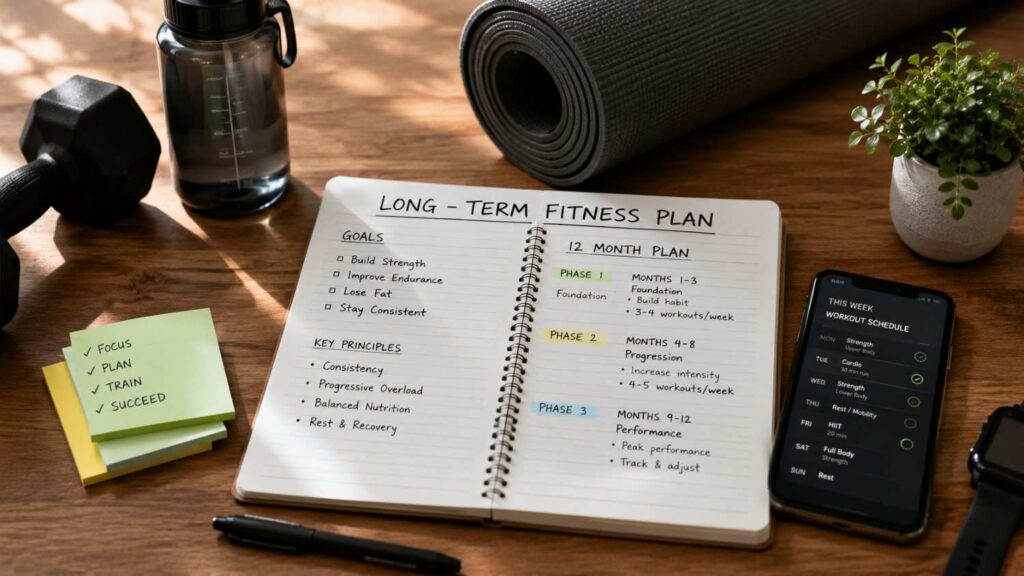
How to Create a Long-Term Fitness Plan
Learning how to create a long-term fitness plan means building an exercise system that can produce progress without depending on perfect motivation, unlimited time, or constant access to the same equipment. The strongest plan is not necessarily the most advanced or demanding. It is the one that matches your goals, current ability, preferred activities, schedule, recovery needs, and environment.
A balanced program usually contains several components. Strength training helps develop or maintain muscular fitness. Aerobic activity supports cardiovascular endurance. Mobility work helps you practise comfortable, controlled movement, while recovery allows your body and mind to respond to training.
The correct balance depends on the person. Someone preparing for a walking event will organize training differently from a person focused on strength, sport performance, weight management, mobility, or general health. Even people with similar goals may need different schedules because their experience, work demands, medical history, sleep, and access to equipment differ.
Public-health guidelines provide a valuable foundation. The Physical Activity Guidelines for Americans recommend that adults work toward 150 to 300 minutes of moderate-intensity aerobic activity each week, or an equivalent amount of vigorous activity, together with muscle-strengthening activity on at least two days. However, these recommendations are not a requirement to begin with the full amount. Some physical activity is better than none, and people who are inactive can start with smaller, manageable sessions.
A complete plan should answer five questions:
- What are you trying to improve?
- What can you currently do safely and consistently?
- What activities will you perform each week?
- How will the workload increase over time?
- How will you adjust when your circumstances change?
The following sections explain how to answer those questions and turn them into a sustainable workout plan.
Define Your Goals and Establish a Realistic Starting Point
A useful fitness plan begins with clarity. Broad statements such as “get in shape,” “be healthier,” or “exercise more” may express a positive intention, but they do not provide enough direction for selecting exercises, scheduling sessions, or evaluating progress. A stronger goal describes what you want to improve and how you will recognize meaningful change.
Your starting point is equally important. The plan should reflect what you can do now, not what you completed several years ago, what a friend can do, or what you hope to manage in the future. Starting with an unrealistic workload often creates excessive soreness, fatigue, scheduling pressure, and frustration. Beginning slightly below your maximum gives you room to practise, recover, and build confidence.
A practical planning process includes six steps:
- Choose one primary goal.
- Add one supporting goal when necessary.
- Record your current activity and ability.
- Identify health, schedule, or equipment limitations.
- Select a repeatable weekly structure.
- Decide which measures will show progress.
Goals should guide decisions rather than create pressure. For example, a person focused on general health may prioritize regular walking and two full-body strength sessions. Someone preparing for a recreational event may need more specific endurance work. A person returning from injury may require professional guidance and a slower progression.
Once you understand both the destination and the starting point, you can choose an appropriate workload instead of copying a generic program designed for someone else.
| Fitness Goal | Primary Training Focus | Recommended Weekly Frequency | Progress Indicator |
|---|---|---|---|
| Weight Loss | Cardio + Strength Training | 4–5 active days | Body measurements, endurance |
| Muscle Gain | Progressive Strength Training | 3–5 strength sessions | Increased weight lifted, muscle growth |
| General Fitness | Balanced Strength + Cardio | 3–4 sessions | Improved energy and consistency |
| Better Endurance | Aerobic Exercise | 4–5 cardio sessions | Longer workout duration |
| Improved Mobility | Mobility + Flexibility Work | Daily or 3–5 sessions | Better range of motion |
Set Specific and Meaningful Fitness Goals
A useful fitness goal describes an observable change. Examples include walking continuously for 40 minutes, completing two strength sessions each week, performing a controlled set of push-ups, improving balance, or preparing for a recreational event.
Connect the goal to a personal reason. A goal based on independence, energy, confidence, health, social participation, or performance often provides clearer direction than exercising only because you believe you should. The reason also helps you decide which activities deserve priority.
Separate outcome goals from process goals. An outcome goal describes the result you hope to achieve. A process goal describes the repeated action that supports it. “Walk five kilometres comfortably” is an outcome goal. “Complete three walking sessions each week for eight weeks” is a process goal.
Process goals are valuable because they remain more directly under your control. You cannot guarantee exactly how quickly your fitness will change, but you can control whether you follow the planned routine.
Avoid pursuing too many major outcomes simultaneously. Trying to maximize strength, endurance, muscle gain, fat loss, sport performance, and flexibility at the same time can make the program unnecessarily complicated. Select one primary focus and maintain other qualities with smaller amounts of training.
If you’re unsure how to match your goals with a realistic routine, this guide to tailored workout plan offers practical examples that complement the planning approach outlined here.
Assess Your Baseline Without Turning It Into a Competition
A baseline assessment shows what you can currently perform and provides a reference point for future review. It does not need to involve an exhausting fitness test, maximum lift, or competitive comparison.
Choose measures related to your goal. You might record your average weekly walking time, a comfortable cycling duration, the resistance used for basic exercises, the number of controlled repetitions you can complete, or how you feel after climbing stairs.
Movement quality matters as much as quantity. Note whether you can perform an exercise with control, whether pain limits a movement, and whether fatigue causes your technique to change. A smaller number of high-quality repetitions provides more useful information than a larger number completed with poor control.
Your baseline should also include practical factors. Record your available training days, access to equipment, average sleep, current activity level, previous injuries, health conditions, and activities you enjoy or dislike.
Avoid comparing your results with another person’s performance. Fitness, health, age, experience, body size, disability, and movement history all affect ability. CDC guidance explains that the same activity may feel moderate to one individual and vigorous to another.
The purpose of assessment is to select a suitable starting workload. It is not to prove your fitness or create embarrassment about where you begin.
Identify Barriers Before They Disrupt the Plan
Most people can predict the situations that are likely to interfere with exercise. Common barriers include long workdays, childcare, travel, limited space, poor weather, crowded gyms, low energy, irregular sleep, and lack of equipment.
Write these barriers down before starting the plan. Then create one realistic response for each problem. A frequent traveller may save a short bodyweight routine. Someone with limited time might schedule three 20-minute sessions instead of relying on two long workouts. A person who dislikes crowded gyms may exercise at home or train during quieter hours.
Distinguish between genuine limitations and flexible preferences. A lack of access to a swimming pool may prevent swimming, but it does not prevent all cardiovascular activity. A busy evening schedule may make after-work sessions difficult, but shorter morning or weekend sessions may remain possible.
Your backup options should be simple enough to use without additional planning. Save the exercises, required equipment, and approximate duration in advance.
CDC recommends choosing enjoyable activities, identifying convenient locations, using shorter opportunities for movement, and finding options that can be completed at home or during travel.
A barrier plan does not remove every difficulty. It prevents one disrupted workout from turning into several inactive weeks because you do not know what to do next.
Build a Balanced Weekly Workout Schedule
A balanced weekly workout schedule distributes training across several days so that you can improve fitness while recovering between demanding sessions. The goal is not to fill every available day. It is to place the right activities in a pattern that you can repeat without excessive fatigue or scheduling conflict.
Beginners often benefit from a simple structure built around full-body strength sessions, moderate aerobic activity, and easy recovery days. More experienced exercisers may divide training into specialized sessions, but additional complexity should solve a specific programming need rather than merely make the plan appear advanced.
Start by scheduling the most important sessions. If strength is the main goal, place strength workouts first. If preparing for an endurance event is the priority, organize the key aerobic sessions before adding supporting work. Mobility and recovery can then be positioned around the more demanding sessions.
The example below offers a flexible general-health structure. It is not a personalized medical or athletic prescription.
| Day | Main activity | Example |
|---|---|---|
| Monday | Strength | Full-body resistance training |
| Tuesday | Aerobic activity | Brisk walking, cycling, or swimming |
| Wednesday | Recovery or mobility | Easy walking and mobility work |
| Thursday | Strength | Full-body resistance training |
| Friday | Aerobic activity | Moderate cardio or suitable intervals |
| Saturday | Enjoyable activity | Sport, hiking, a class, or a longer walk |
| Sunday | Rest or gentle movement | Rest, stretching, or relaxed walking |
The exact days can change. What matters is the relationship between training demand, recovery, and your real schedule.
Combine Strength, Cardio, and Mobility
A balanced general fitness plan usually includes strength training, cardiovascular exercise, and mobility work because each component supports a different aspect of physical function.
Strength training helps develop or preserve muscular strength and endurance. A basic full-body routine may include a squat or sit-to-stand movement, a hip-hinge pattern, pushing, pulling, carrying, and controlled trunk exercises. The specific movements should match your ability, equipment, and goals.
Cardiovascular exercise increases heart rate and breathing. Brisk walking, cycling, swimming, running, dancing, rowing, and many sports can contribute. Moderate intensity usually allows you to speak in short sentences, while vigorous activity makes conversation more difficult, although perceived intensity varies between individuals.
Mobility training involves practising controlled movement through the ranges required for exercise and daily life. It can be included in a warm-up, added after training, or completed as a short session on an easier day. Mobility work should be selected according to actual movement needs rather than performed randomly.
CDC guidance recommends combining aerobic activity with muscle-strengthening work for all major muscle groups. It also explains that activity can be spread throughout the week and divided into shorter periods.
The balance between these components can change according to your main goal, but completely ignoring one category may make a general health program less complete.
Choose a Frequency You Can Repeat
Workout frequency describes how often you train during the week. The right number of sessions depends on your goal, experience, recovery, available time, and the difficulty of each workout.
Beginners do not need to train hard every day. Two full-body strength sessions and several manageable walking, cycling, or other aerobic sessions can provide a practical starting point. This schedule offers enough repetition to practise exercises while leaving recovery time between demanding workouts.
Experienced individuals may train more frequently because they can divide the workload between movement patterns or muscle groups. However, higher frequency is only useful when it improves training quality and remains compatible with recovery.
Schedule your most important sessions first. Additional activity should be optional rather than required for the week to feel successful. For example, two strength workouts may be the minimum commitment, while a third session is added only when time and recovery allow.
Consider how long each workout takes. Three 30-minute sessions may fit your life more easily than two 75-minute sessions, even when the weekly training time is similar.
A repeatable three-day plan is more valuable than a six-day routine you abandon after two weeks. Public-health guidance also demonstrates that aerobic and strength activity can be distributed across the week in several different ways.
Create Full, Short, and Minimum Workout Versions
Every important workout should have more than one format. This allows the routine to continue when time, energy, travel, or equipment access changes.
The full version is the complete planned session. A full strength workout may include five or six exercises, several working sets, and an appropriate warm-up.
The short version contains the highest-priority movements and removes optional volume. It may include one lower-body exercise, one push, one pull, and one trunk movement. This version can often be completed in 20 to 30 minutes.
The minimum version is the smallest useful activity that preserves the routine. It might include a ten-minute walk, one set of several basic movements, or a short mobility sequence.
These alternatives reduce all-or-nothing thinking. Completing the short version does not mean the workout failed. It means the program adapted to the current situation.
Decide which exercises belong in each version before a busy day occurs. Otherwise, you may spend the available time deciding what to remove.
Shorter sessions still contribute to weekly movement. CDC guidance confirms that adults can spread physical activity across the week and divide it into smaller periods. The minimum version should not replace all full workouts indefinitely, but it can protect consistency during temporary disruptions.
Related Articles
Progress Gradually, Recover Well, and Review the Plan
A long-term fitness plan must evolve as your body adapts. Repeating the same workload indefinitely may eventually stop producing meaningful improvement, while increasing every training variable too quickly can create excessive fatigue, poor technique, loss of motivation, or difficulty recovering.
Progression means gradually increasing an appropriate training demand. Recovery gives your body time to respond to that demand. Review allows you to decide whether the balance between the two is producing the result you want.
A useful progression does not always involve heavier weights or harder workouts. Improvement may include more controlled repetitions, better balance, longer walking duration, reduced rest between moderate efforts, greater confidence, or more consistent attendance.
Whenever possible, change one major variable at a time. You might add a repetition to each set, increase resistance slightly, extend one aerobic session, or add one additional weekly walk. Changing resistance, volume, frequency, intensity, and exercise complexity simultaneously makes the increase difficult to evaluate.
Recovery should be planned rather than treated as something that happens only when you become exhausted. Consider sleep, nutrition, hydration, rest days, workload outside the gym, and signs of persistent fatigue.
Review the plan every four to eight weeks. Ask whether your performance, consistency, and daily function are improving. Also check whether the schedule remains realistic. Keep successful elements instead of replacing the entire routine simply because a review date arrives.
A strong program changes enough to remain effective but stays stable enough for you to practise and measure progress.
Apply Progressive Overload Carefully
Progressive overload means gradually increasing the challenge placed on the body as the current workload becomes manageable. It is a principle rather than a single method.
In strength training, you might add a small amount of resistance, complete another repetition, increase a set, improve range of motion, or perform the same work with better control. In aerobic training, progression may involve extending duration, increasing pace, adding a small incline, or completing an additional session.
Do not increase every variable during the same week. Adding resistance, repetitions, sets, frequency, and intensity together can create a much larger increase than expected.
Progress should preserve movement quality. If additional weight causes major technique breakdown, pain, or a loss of control, the increase may be premature. The same principle applies to cardio. A faster pace is not useful when it forces you to abandon the planned duration or leaves you unable to recover for the next session.
Increase training only after the current level feels stable. Stability means you can complete the workload with appropriate technique and recover within a reasonable period.
CDC guidance recommends that people beginning or increasing physical activity start slowly and work toward longer or more demanding sessions over time. Gradual progression is especially important after illness, injury, or a long period of inactivity.
Treat Recovery as Part of Training
Recovery is the process through which your body and mind respond to exercise. It includes sleep, nutrition, hydration, rest, stress management, and the spacing of demanding sessions.
Training creates a challenge. Recovery allows adaptation. When hard exercise is repeatedly added to inadequate sleep, poor nutrition, illness, or high life stress, performance may decline instead of improving.
Most adults need at least seven hours of sleep, although individual needs and recommended ranges vary by age. Consistent sleep supports general health, alertness, and normal functioning. A person who regularly sleeps poorly may need a smaller training workload than someone with the same fitness level who recovers well.
Rest days do not always require complete inactivity. Active recovery may include relaxed walking, easy cycling, gentle mobility, or another activity that feels easier than normal training. The goal is restoration rather than adding another challenging workout.
Pay attention to persistent pain, worsening symptoms, unusual fatigue, reduced performance, and changes in normal movement. These signs should not automatically be treated as a lack of discipline.
Stop or modify activity when necessary and seek appropriate professional guidance for persistent problems. People with medical conditions, disability, pregnancy, or complex rehabilitation needs may benefit from advice from a healthcare professional, physical therapist, or qualified fitness specialist.
Track Progress and Adjust Every Few Weeks
Progress tracking gives you evidence about whether the plan is working. Without records, it is easy to underestimate improvement, repeat the same workload indefinitely, or make unnecessary changes based on one difficult workout.
Choose a small number of measures that relate directly to your goals. Useful options include:
- Workouts completed
- Walking, running, or cycling duration
- Resistance and repetitions
- Exercise technique
- Range of motion
- Energy and recovery
- Confidence with specific movements
- Difficulty of daily tasks
Record enough detail to guide decisions without turning tracking into another demanding task. A simple notebook, calendar, spreadsheet, or fitness application may be sufficient.
Review the information every four to eight weeks. Look for trends rather than judging one session. A single poor performance may reflect sleep, stress, illness, or an unusually busy day.
When progress slows, examine consistency first. Then review movement quality, training difficulty, recovery, and whether the goal remains realistic.
Do not replace the full program automatically. You may only need to increase one exercise, reduce unnecessary volume, move a session, change an activity you dislike, or schedule an easier week.
| Review Area | What to Monitor | When to Adjust |
|---|---|---|
| Workout Consistency | Sessions completed each week | If workouts are frequently missed |
| Strength Progress | Repetitions, sets, resistance | When exercises become too easy |
| Cardio Performance | Time, distance, or pace | If endurance plateaus |
| Recovery Quality | Sleep, soreness, energy levels | When fatigue remains high |
| Goal Progress | Fitness milestones achieved | Every 4–8 weeks based on results |
The plan should evolve while preserving its useful foundation. Frequent random changes make it difficult to develop skill or understand which methods are effective.
Reviewing your routine regularly is one of the most effective ways to maintain long-term fitness success while adapting your plan to changing goals, recovery, and daily responsibilities.
Quick Answer About How to Create a Long-Term Fitness Plan
To create a long-term fitness plan, begin with one clear primary goal and assess what you can realistically do today. Build a weekly schedule that includes appropriate strength training, aerobic activity, mobility, and recovery without filling every available day. Start below your maximum capacity so you have room to improve rather than beginning with a workload you cannot sustain.
Choose exercises you can perform safely and repeat consistently. Progress by changing one variable at a time, such as resistance, repetitions, duration, exercise difficulty, or weekly frequency. Track a small number of meaningful measures, including completed sessions, walking or cycling time, weights used, repetitions, movement quality, energy, or recovery.
Review the plan every four to eight weeks. Keep the parts that are working and adjust only what no longer fits your goals, schedule, ability, or available equipment.
A good plan should also include shorter alternatives for busy periods. Your full workout might last 45 minutes, but a short version could take 20 minutes, while a minimum version may involve a walk and two basic exercises. This flexible structure helps preserve consistency without treating every interrupted week as failure.
Public-health guidelines offer a useful destination, but they do not require everyone to begin at the full recommended amount. People returning after inactivity may need to start with smaller amounts of activity and progress gradually.
What a Long-Term Fitness Plan Includes
A long-term fitness plan is a structured but adaptable system for improving or maintaining physical fitness over months and years. It connects your goals with specific activities, a repeatable weekly schedule, gradual progression, planned recovery, and regular evaluation.
The plan should identify the type of training you will complete, the days or situations in which it will occur, and the measures you will use to judge progress. It should also explain how you will respond when time, energy, health, travel, weather, or equipment access changes.
Most general fitness plans include a combination of aerobic activity, muscle-strengthening exercise, mobility practice, and rest. CDC guidance recommends that adults work toward at least 150 minutes of moderate-intensity aerobic activity each week, or 75 minutes of vigorous activity, together with muscle-strengthening work on at least two days. Activity may be divided into smaller sessions throughout the week.
These recommendations provide useful direction, but an individual starting plan may be smaller. Someone returning after a long break might begin with short walks and two simple strength sessions before gradually increasing the total workload. The plan should bridge the gap between the current starting point and the desired level of fitness.
Why Sustainability Matters More Than Perfection
A perfect workout program is useless when it cannot survive ordinary life. Work deadlines, family responsibilities, poor sleep, travel, illness, weather, and changes in motivation can all interrupt training. A sustainable plan expects these disruptions and includes practical ways to continue at a reduced level.
Many short-lived programs are built around an ideal week. They assume unlimited time, stable energy, easy access to equipment, and no competing priorities. When one condition changes, the entire routine collapses because there is no alternative version.
Sustainability means choosing a frequency, duration, and difficulty you can repeat without relying on constant enthusiasm. It also means accepting that progress is not perfectly linear. Some weeks will include stronger performances, while others may focus on maintaining the habit or recovering.
Create a minimum standard for difficult periods. This could be two short workouts, several walks, or a simplified home routine. Completing the minimum keeps the behaviour active and makes it easier to return to the full schedule.
CDC guidance recommends selecting enjoyable activities that match your ability, planning specific times for movement, tracking activity, and progressing gradually. These strategies turn exercise into a repeatable system rather than an occasional burst of motivation.
Frequently Asked Questions About How to Create a Long-Term Fitness Plan
People creating a fitness routine often focus on finding the perfect number of workout days, the best exercises, or the fastest progression method. These questions are understandable, but the correct answer usually depends on the person’s goals, health, experience, schedule, and recovery.
A beginner may improve with a small number of well-organized sessions, while an experienced athlete may require greater volume or specialization. A person training at home may use different exercises from someone with access to a fully equipped gym, even when both are working toward similar outcomes.
The most reliable plan is built around principles rather than rigid rules. It should include appropriate strength and aerobic activity, a manageable schedule, gradual progression, and enough recovery. It should also provide alternatives for busy periods, travel, and unexpected interruptions.
The answers below address common search questions about training frequency, program duration, rest days, missed workouts, and motivation. They provide general education rather than personalized medical, rehabilitation, or athletic programming.
People with chronic conditions, persistent pain, disability, pregnancy, recent surgery, or a long period of inactivity may need individualized guidance before beginning demanding exercise. A healthcare professional, physical therapist, or qualified fitness professional can help adapt activities and progression.
Remember that consistency does not require every week to look identical. A long-term plan should be stable enough to guide action but flexible enough to remain useful as circumstances change.
How many days a week should I exercise?
The right number of exercise days depends on your goal, current ability, health, schedule, and the difficulty of each session. More days are not automatically better.
Adults can distribute aerobic activity throughout the week and should include muscle-strengthening activity on at least two days. A beginner might start with two strength sessions, two or three walks, and several easy movement opportunities rather than attempting demanding daily workouts.
Count active days separately from hard training days. A relaxed walk, mobility session, or recreational activity may contribute to movement without creating the same recovery demand as heavy strength training or vigorous intervals.
The total weekly workload matters more than the number of days alone. Five short, manageable sessions may be easier to sustain than three long workouts. Another person may prefer fewer sessions because of work or family responsibilities.
Start with a frequency that leaves you feeling capable of repeating the schedule. Add another session only when the current routine feels stable and recovery remains appropriate.
The best weekly frequency is not the maximum number of days you can tolerate temporarily. It is the number you can complete consistently while maintaining movement quality, recovery, and normal responsibilities.
How long should I follow the same workout plan?
Follow the same basic structure long enough to practise the exercises, develop skill, and evaluate whether the program is producing progress. Constantly replacing exercises makes it difficult to compare performance or determine what is effective.
Many people can review a routine after approximately four to eight weeks without automatically changing it. A review does not mean every exercise must be replaced. It means examining whether the schedule, workload, movement selection, and progress measures still support the goal.
Keep exercises that are safe, suitable, and improving. Adjust movements that cause discomfort, require unavailable equipment, no longer match the goal, or cannot be progressed effectively.
Experienced exercisers may follow the same fundamental movement patterns for much longer while changing repetitions, resistance, sets, tempo, or exercise variations.
Change the plan when your goal, ability, schedule, equipment, recovery, or health status changes. Do not replace a successful routine merely because it has become familiar. Familiarity can improve technique and allow more reliable progression.
A stable program provides a clear reference point. A flexible program adapts when necessary. The strongest long-term fitness plan combines both qualities instead of treating novelty as the main source of progress.
Should I focus on strength training or cardio?
Most general fitness plans should include both strength training and cardiovascular exercise because they support different physical qualities.
Strength training develops or preserves muscular strength and endurance. It can support daily tasks, movement capacity, and long-term physical function. Cardiovascular exercise improves aerobic fitness and may include walking, cycling, swimming, running, dancing, or sport.
The balance should reflect your primary goal. A person focused on strength may complete more resistance training and use moderate cardio as support. Someone preparing for a distance event may prioritize aerobic sessions while maintaining strength with a smaller amount of resistance work.
You do not necessarily need to complete both forms of training in every session. They can be distributed across separate days or combined when scheduling requires it.
When strength and cardio occur in the same workout, complete the activity that relates most closely to your main goal first, after an appropriate warm-up. This allows you to perform the priority work with greater focus.
CDC guidance recommends both aerobic and muscle-strengthening activity for adults. Completely excluding one category may make a general fitness plan less balanced, although specific medical, performance, or rehabilitation circumstances can require individualized modifications.
How many rest days do I need?
Rest needs vary according to exercise intensity, training volume, experience, age, sleep, nutrition, health, and stress outside training. There is no universal number that applies to everyone.
A beginner completing two or three moderate workouts may need less structured recovery than an experienced athlete performing frequent high-volume sessions. However, beginners may also experience greater soreness because the activities are unfamiliar.
Schedule enough time between demanding sessions for the same muscles when fatigue affects technique or performance. This does not always require complete inactivity. Easy walking, gentle cycling, or mobility work may be appropriate when it feels restorative.
Monitor your response over several weeks. Persistent fatigue, declining performance, worsening discomfort, poor sleep, irritability, or a loss of enthusiasm may indicate that the workload or recovery strategy needs review.
Rest should support the next training session rather than create anxiety about losing progress. Fitness does not disappear because of one or two easier days.
The most useful recovery schedule allows you to complete planned workouts with appropriate effort and movement quality. When uncertainty involves pain, illness, injury, or a medical condition, seek professional guidance instead of using a general rest-day rule.
What should I do after missing several workouts?
Resume with a manageable version of the plan rather than trying to repay every missed session. Adding several workouts to one week can create excessive fatigue and does not restore lost consistency.
Consider why the interruption occurred. A short break caused by travel may require only a small reduction in workload. A longer break caused by illness, injury, or several inactive months may require a more gradual return.
Reduce resistance, sets, repetitions, duration, or intensity during the first sessions back. Focus on comfortable movement and familiar exercises. You can rebuild toward the previous workload as technique and recovery improve.
Do not use the first session after a break as a fitness test. Maximum efforts often create unnecessary soreness and may delay the return to regular training.
Review the barrier that caused the interruption. When work repeatedly disrupts evening workouts, move sessions to more stable times or create shorter alternatives. When travel is common, prepare a portable routine.
Missing several workouts does not erase your previous progress. The most important action is restarting at an appropriate level. A long-term plan should include return strategies so that temporary interruptions do not become permanent abandonment.
How do I stay motivated long term?
Long-term consistency should not depend entirely on motivation because motivation naturally changes. Build systems that make exercise easier to begin even when enthusiasm is low.
Schedule workouts at specific times, prepare equipment in advance, choose activities you enjoy, and reduce unnecessary setup. A short walk that begins at your front door may be easier to maintain than a complicated routine requiring a long journey.
Track completion rather than waiting for dramatic results. Seeing several weeks of consistent activity can reinforce the behaviour even when physical changes are gradual.
Use full, short, and minimum workout versions. This gives you an acceptable option during busy or low-energy periods and reduces the temptation to skip everything.
Social support may also help. A training partner, class, coach, family member, or online community can provide structure and accountability. Choose support that encourages safe consistency rather than comparison or pressure.
Reconnect with the reason behind the goal. Improved energy, confidence, health, independence, or participation may remain meaningful when excitement about a particular workout fades.
CDC recommends selecting enjoyable activities, planning specific times, tracking movement, and involving other people for encouragement. Motivation can begin action, but systems and realistic expectations are what allow the routine to continue.
Conclusion
Knowing how to create a long-term fitness plan is less about finding a perfect routine and more about building a system that you can repeat, evaluate, and adjust. The plan should be clear enough to guide your weekly actions but flexible enough to remain useful when work, family, travel, health, or access to equipment changes.
Begin with one meaningful goal and an honest baseline. Decide which physical qualities matter most, then create a weekly schedule containing appropriate strength training, aerobic activity, mobility, and recovery. Start below your maximum capacity so you can practise movements, build confidence, and increase the workload gradually.
Progress does not require constant novelty. Keep exercises and routines that work. Add difficulty through small, controlled changes in resistance, repetitions, duration, exercise quality, or frequency.
Recovery is part of the program rather than time lost from it. Sleep, nutrition, hydration, easier days, and stress management influence your ability to adapt. Persistent pain or worsening symptoms require appropriate modification and may require professional assessment.
Track a few measures that relate directly to your goal. Review the information every four to eight weeks and change only what needs adjustment. A successful review might result in a slightly harder workout, a simpler schedule, a different exercise, or an easier recovery week.
The strongest plan supports real life. It provides complete sessions when time and energy are available, shorter options during busy periods, and a clear process for returning after interruptions.
Long-term fitness develops through repeatable progress, not perfect weeks.
Build for Real Life
Your fitness plan should work during normal weeks rather than only when time, energy, and motivation are unusually high. Real life includes deadlines, family responsibilities, poor sleep, travel, illness, and unexpected changes.
Create a schedule around the time you usually have, not the time you hope to have. When weekday evenings are unpredictable, early morning, lunchtime, or weekend sessions may offer greater stability.
Use full, short, and minimum workout versions. The full session may contain the complete planned workload. The short version keeps the essential exercises, while the minimum version preserves the behaviour with a small amount of movement.
These alternatives allow the routine to bend without breaking. Temporarily reducing a workout is often more effective than forcing an unrealistic session and then abandoning the plan.
Review your schedule whenever work, health, family duties, or equipment access changes. A useful program should adapt to the current situation while continuing to serve the same broader goal.
Regular physical activity provides immediate and long-term benefits, and some activity is better than none. A reduced week still has value.
Building for real life means designing a plan that expects interruptions and includes a practical route back to normal training.
Focus on Repeatable Progress
Repeatable progress means improving at a rate you can sustain without sacrificing technique, recovery, or consistency. It values small, reliable changes over occasional extreme efforts.
Track measures that relate to your goal. Strength progress may appear as additional resistance, more controlled repetitions, or improved movement quality. Endurance progress may involve longer duration, greater distance, or a lower perceived effort at the same pace.
Progress can also appear outside formal workouts. Daily tasks may feel easier, recovery may improve, or you may complete planned sessions more consistently.
Increase one major training demand at a time. This makes the response easier to evaluate and reduces the chance of adding more stress than intended.
Not every week needs to produce a personal record. Some weeks maintain current ability, practise technique, or reduce fatigue. Easier periods can support future progress rather than interrupt it.
Use professional guidance when medical conditions, persistent pain, disability, pregnancy, rehabilitation, or advanced performance goals require individual planning.
The best long-term plan balances ambition with patience. It encourages continued improvement while leaving enough flexibility for normal changes in energy, schedule, and life circumstances.