
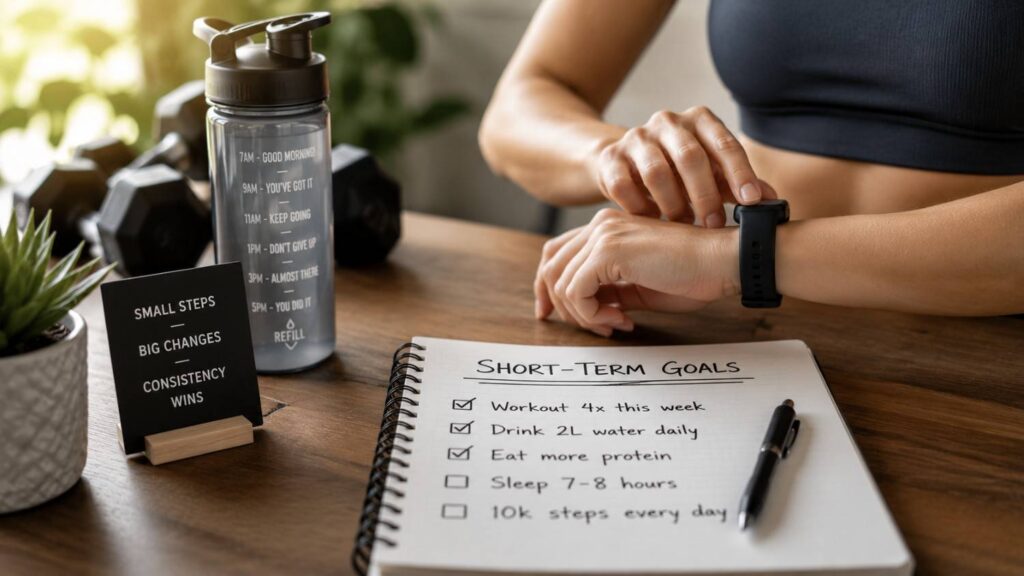
The Benefits of Short-Term Fitness Goals: Small Targets, Lasting Progress
Large fitness ambitions can provide direction, but they rarely explain what someone should do during the next workout, week, or month. A person may want to become stronger, improve cardiovascular health, complete a race, reduce discomfort, or remain active with age. These goals are meaningful, but they are too broad to guide daily decisions without smaller milestones.
Short-term targets bridge the gap between a long-term vision and immediate action. They divide a large objective into practical behaviors that can be scheduled, measured, and adjusted. This helps beginners avoid feeling overwhelmed and gives experienced exercisers a structured way to manage training blocks, performance targets, recovery periods, and changing priorities.
A well-designed short-term goal also changes the way progress is evaluated. Success is no longer limited to a distant result such as reaching a particular body weight or finishing an event. Progress can include completing planned sessions, improving technique, increasing walking time, recovering more consistently, or developing a routine that fits everyday responsibilities.
The purpose is not to create constant pressure or turn every workout into a test. Effective goals provide direction while remaining flexible enough to accommodate illness, work demands, travel, stress, and recovery. When connected to a meaningful long-term objective, small targets can support lasting fitness progress without encouraging all-or-nothing thinking.
What Are Short-Term Fitness Goals?
Short-term fitness goals are near-term objectives that support a wider health, exercise, or performance plan. They can focus on what a person does, how often an activity is completed, how well a movement is performed, or how a specific performance measure changes. Their purpose is to create a manageable target that can guide decisions during a defined period.
A short-term goal should reflect the individual’s current starting point. Someone who has not exercised regularly may benefit from a goal based on attendance or walking frequency. A more experienced person may focus on improving technique, increasing training volume gradually, or preparing for a specific event. The same goal is not appropriate for every person because fitness level, health status, available time, equipment, and personal priorities differ.
These goals are most effective when they are connected to a larger reason for exercising. A person who wants to remain mobile while aging may begin with two weekly strength sessions. Someone preparing for a hiking holiday may establish a four-week walking and stair-climbing target. The short-term objective provides a practical step without losing sight of the broader purpose.
Understanding this distinction prevents goals from becoming random challenges. A useful target does not simply create more activity. It directs effort toward a meaningful outcome and provides enough information to evaluate whether the chosen approach is working.
Short-Term Goals Focus on the Next Action
A long-term goal describes a destination, while a short-term goal identifies the next action required to move toward it. For example, completing a 10K race may be an important long-term objective, but it does not explain how someone should train this week. A short-term target such as completing three planned walk-run sessions per week for four weeks provides immediate direction.
This focus can reduce decision fatigue. Instead of repeatedly deciding whether, when, or how to exercise, the person already has a defined plan. The activity has been chosen, the sessions have been scheduled, and the expected frequency is clear. This makes it easier to begin, especially on days when enthusiasm is lower.
Short-term goals also improve the quality of review. After the planned period, the individual can examine whether the sessions were completed, how difficult they felt, and whether the routine fit daily life. The next step can then be based on real information. This creates a more reliable planning process than repeatedly choosing workouts based on mood, convenience, or temporary motivation.
Process Goals Are Often More Controllable
Fitness goals generally fall into two broad categories: outcome goals and process goals. An outcome goal describes a result, such as running a faster mile, lifting a particular weight, or reducing a health measurement. A process goal focuses on the actions that may contribute to that result, such as completing two strength sessions per week or walking after dinner on four evenings.
Process goals are often more controllable because a person can directly decide whether to perform the planned behavior. Outcomes may be influenced by sleep, stress, nutrition, genetics, illness, training history, medication, and other factors. Even when a person follows a program carefully, the final result may develop more slowly than expected.
For this reason, I recommend using process goals as the foundation of most short-term plans. An outcome can still provide direction, but daily and weekly success should be measured primarily through controllable actions. This approach creates a fairer and more useful definition of progress. It also reduces the risk of abandoning a sound routine simply because a physical result has not appeared on an idealized timetable.
The Core Benefits of Short-Term Fitness Goals
The benefits of short-term fitness goals extend beyond simple organization. These targets can improve focus, support motivation, make progress more visible, and provide a structured way to evaluate whether an exercise plan is appropriate. They also help transform a large objective into a sequence of manageable decisions.
A shorter time frame creates urgency without requiring an extreme deadline. Knowing that a goal will be reviewed in four or six weeks encourages attention to current behavior. At the same time, the limited period makes the target feel more approachable than a commitment that appears to continue indefinitely.
Short-term goals can also improve communication with a coach, trainer, healthcare professional, or exercise partner. A specific target makes it easier to discuss what has been completed, what feels difficult, and what needs to change. Rather than reporting that a program is “going well” or “not working,” the individual can refer to completed sessions, pain levels, exercise duration, or another relevant measure.
Most importantly, short-term milestones provide opportunities to learn. Every goal produces information about personal preferences, scheduling barriers, recovery needs, and realistic levels of difficulty. This information allows future plans to become more individualized. The goal is therefore not only to achieve a result but also to develop a better understanding of what supports sustainable participation.
They Improve Focus and Motivation
Clear fitness goals reduce ambiguity. When a person knows which activity to complete, how often to perform it, and when progress will be reviewed, attention can be directed toward execution rather than repeated decision-making. This clarity is particularly valuable for beginners who may feel uncertain about where to start or how much exercise is appropriate.
The American Heart Association explains that clear goals can support motivation and that monitoring progress may help people remain engaged with an exercise program. Research also suggests that specific goal-setting interventions can increase physical activity among adults who are not sufficiently active. However, a goal should still feel personally relevant. A perfectly written target will have limited value if the activity is disliked or the reason behind it is unimportant.
Motivation should therefore be treated as a changing resource rather than a permanent requirement. A structured goal helps people act even when enthusiasm is lower because the decision has already been made. Over time, completing planned actions can create evidence of capability, which may strengthen confidence and make continued participation feel more achievable.
They Create Faster Feedback
A short-term target creates a natural checkpoint. Instead of waiting several months to decide whether a program is effective, a person can review the plan after a defined period such as two, four, or six weeks. This review can include completed workouts, changes in energy, exercise difficulty, soreness, enjoyment, scheduling problems, and performance measures.
Faster feedback makes adjustment easier. If the goal was too demanding, the frequency or duration can be reduced. If the target was consistently achieved without excessive fatigue, the next goal may include a modest progression. If the activity was unpleasant, another form of movement may be more suitable. These decisions are more reliable when they are based on recorded experience rather than memory alone.
This process also helps prevent wasted effort. Without review points, a person may continue following a routine that does not match current needs or may abandon a useful program because progress feels invisible. Short-term evaluation provides context. It separates a normal period of gradual adaptation from a genuine problem with scheduling, exercise selection, recovery, or goal design.
They Build Accountability and Confidence
Measurable goals make personal commitments more visible. Recording completed sessions, active minutes, repetitions, distance, or technique practice creates a clear record of follow-through. This can strengthen accountability because the individual is no longer relying on a vague impression of having exercised “more often.”
Accountability can also involve another person. A coach, friend, family member, class instructor, or training partner may help someone remember the goal, discuss barriers, or celebrate progress. The purpose is not to create pressure or comparison. Effective accountability should support consistency while respecting the person’s ability, privacy, and changing circumstances.
Confidence develops when people accumulate evidence that they can complete planned actions. A beginner who follows a twice-weekly walking plan for one month has demonstrated reliability, even if dramatic physical changes have not occurred. That evidence can make the next target feel more realistic. Repeated success also encourages a more balanced view of progress. Fitness becomes a skill that can be developed through planning and adjustment rather than a test of willpower that someone either passes or fails.
Related Articles
How Short-Term Goals Support Long-Term Fitness Progress
Short-term milestones are most valuable when they contribute to a broader objective. A series of disconnected challenges may create temporary activity, but it does not necessarily support lasting health or performance. Long-term progress requires continuity, gradual development, and a clear reason for choosing each short-term target.
The relationship can be compared to a route and its individual stages. The long-term goal identifies the destination, while shorter goals define the next practical section of the journey. Someone who wants to improve cardiovascular endurance may begin by establishing a consistent walking routine before increasing duration or intensity. A person seeking greater strength may first learn movement technique and develop regular attendance before focusing on heavier resistance.
This structure supports safer progression because each stage can be reviewed before the next level is introduced. It also allows the plan to respond to changing circumstances. A new work schedule, injury, illness, or shift in priorities may require the next goal to focus on maintenance rather than improvement.
Long-term fitness rarely follows a perfectly straight path. Progress may accelerate, slow down, or temporarily reverse. Short-term goals provide manageable periods in which to focus, learn, and adjust. They keep the larger objective relevant without demanding that every workout produce an obvious result.
Small Milestones Reduce Overwhelm
Large goals can become overwhelming when they contain too many undefined steps. A statement such as “become healthier” may include exercise, nutrition, sleep, stress management, medical care, and lifestyle changes. Trying to address every area at once can lead to confusion, unrealistic expectations, and early abandonment.
A small milestone narrows attention. “Walk for 15 minutes after dinner four times this week” is easier to schedule and evaluate. It does not require a complete lifestyle transformation before progress can begin. Once that behavior becomes manageable, the next goal may involve a slightly longer walk, an additional day, or a new form of activity.
The CDC encourages people to select enjoyable activities, reserve specific times for movement, and begin at a manageable level before gradually increasing the challenge. These recommendations support a progressive approach rather than an immediate attempt to meet an ideal standard. Reducing overwhelm does not mean lowering ambition permanently. It means organizing ambition into steps that a person can realistically complete and build upon.
Consistency Can Grow Into a Sustainable Routine
Consistency develops when an activity fits a person’s schedule, ability, preferences, and environment. A short-term goal provides a structured period in which to test these factors. Someone may discover that morning workouts are frequently interrupted but lunchtime walks are easier to maintain. Another person may find that group classes provide more accountability than exercising alone.
These discoveries matter because a sustainable routine is not created by repetition alone. It is created by identifying a practical combination of timing, activity, difficulty, and support. Short-term targets allow each element to be evaluated without assuming that the first plan must remain permanent.
The aim should not be to complete an endless series of intense challenges. Instead, each milestone should strengthen the underlying routine. A person might begin by attending two weekly sessions, then focus on improving technique, and later add a modest amount of training volume. The activities change, but the habit of planned participation remains. Over time, consistency can become less dependent on temporary motivation and more connected to established routines and personal identity.
Short-Term vs. Long-Term Fitness Goals
Short-term and long-term goals perform different but complementary functions. A long-term objective provides direction by describing what someone hopes to achieve or maintain over many months or years. A short-term target turns that direction into a specific action that can be completed and reviewed in the near future.
Problems often arise when only one type is used. A long-term goal without smaller milestones may feel distant and difficult to manage. A short-term goal without a broader purpose may become an isolated challenge that produces activity but no lasting direction. Effective fitness planning connects both levels.
For example, someone may want to remain strong and independent as they age. That long-term purpose can guide several shorter goals, including attending strength sessions twice per week, learning safe lifting technique, improving balance, and maintaining mobility. Each short-term milestone contributes to the larger objective while addressing a different part of the process.
The time frames should remain flexible. A long-term goal may change as health, interests, responsibilities, or capabilities develop. Short-term goals should also be revised when they no longer support the desired direction. The purpose of the comparison is not to decide which type is better. It is to understand how each one contributes to a complete and adaptable fitness plan.
Key Differences at a Glance
The most important difference is the level of detail. A long-term goal describes a broad destination, while a short-term goal describes a measurable step. Long-term goals may involve lifestyle, health, independence, or performance. Short-term goals usually focus on a limited number of behaviors or outcomes that can be evaluated within weeks or months.
| Goal Element | Short-Term Fitness Goal | Long-Term Fitness Goal |
|---|---|---|
| Time frame | Days, weeks, or several months | Many months, years, or an ongoing lifetime objective |
| Main purpose | Direct immediate action and provide feedback | Establish an overall direction or desired future state |
| Example | Strength train twice weekly for six weeks | Maintain strength and mobility throughout adulthood |
| Best metric | Sessions, minutes, repetitions, distance, or technique | Performance, health, sustained ability, or lifestyle capacity |
| Review cycle | Weekly, monthly, or at the end of a training block | Quarterly, annually, or after major life changes |
| Adjustment style | Frequent and specific | Broader and less frequent |
These differences show why both levels are necessary. The long-term objective provides meaning, while the short-term target makes the next step practical.
The Strongest Plans Connect Both
A strong fitness plan begins with the larger reason for exercising and then identifies a near-term behavior that supports it. This connection prevents goals from becoming arbitrary. A person who wants enough endurance to enjoy hiking might set a four-week target of completing three brisk walks per week. Someone who wants to manage daily tasks more comfortably might focus on basic strength and mobility.
The connection should be clear enough that the individual can explain why the short-term action matters. If a goal does not support the broader objective, it may need to be changed. For instance, adding a high-intensity challenge simply because it is popular may not be appropriate for someone whose primary aim is pain-free movement and sustainable activity.
Connected goals also make setbacks easier to interpret. Missing one short-term target does not mean the long-term objective has failed. The person can adjust the method while keeping the larger purpose. This flexibility encourages persistence because the destination remains stable even when the route changes.
How to Set Effective Short-Term Fitness Goals
Creating an effective goal requires more than choosing an activity and attaching a deadline. The target should reflect the individual’s current ability, available time, health considerations, preferences, and broader purpose. It should also include a practical method for measuring progress.
The process begins with an honest baseline. A person who currently walks once per week should not automatically plan six demanding sessions simply because that schedule appears more impressive. A moderate progression is more likely to support consistency and reduce unnecessary fatigue. The goal should challenge the person without making success dependent on perfect circumstances.
Effective planning also includes implementation details. It is not enough to decide that two workouts will occur each week. The person should identify likely days, times, locations, and backup options. Anticipating common barriers turns a written goal into an operational plan.
Review is equally important. At the end of the target period, the person should examine what was completed, what interfered, and how the body responded. A successful goal may be progressed, repeated, or maintained. An unsuccessful goal may need to be simplified or redesigned. The review should produce useful information rather than judgment.
When this process is repeated, fitness goal setting becomes a practical skill. Each cycle helps the person understand how to create targets that are increasingly realistic and personalized.
Use SMART as a Framework, Not a Formula
The SMART framework describes goals that are specific, measurable, attainable, relevant, and time-bound. It can help transform a broad intention into a usable target. For example, “For the next four weeks, I will complete two 30-minute beginner strength sessions every week” identifies the activity, duration, frequency, and review period.
However, the acronym should not be treated as a complete solution. A goal can meet every SMART criterion and still fail if it lacks personal meaning, does not fit the individual’s schedule, or creates inappropriate pressure. Exercise and Sports Science Australia has emphasized that effective goals also require an appropriate level of difficulty, personal relevance, and a practical implementation plan.
A helpful way to use SMART is as a quality check. After writing the goal, ask whether the action is clear, whether progress can be observed, whether the target is realistic, whether it supports a meaningful purpose, and when it will be reviewed. Then consider the human factors: enjoyment, confidence, support, health status, and likely barriers.
Follow a Five-Step Goal-Setting Process
A structured process makes fitness goals easier to design and review. The following five steps can be used by beginners, experienced exercisers, and professionals supporting clients:
- Record the current baseline. Note existing exercise frequency, walking time, repetitions, distance, mobility, or another relevant measure.
- Choose one priority. Focus on consistency, strength, endurance, mobility, balance, recovery, or technique rather than trying to improve everything simultaneously.
- Define the behavior. State exactly what activity will be performed and how completion will be measured.
- Choose a realistic review date. Select a period that allows enough repetition to observe patterns.
- Evaluate and adjust. Review completion, difficulty, enjoyment, barriers, and physical response.
One thing I always check first is whether the goal fits the person’s actual calendar. A technically well-written target will still be ineffective if the sessions conflict with regular work, family, travel, or recovery demands. Practical scheduling should therefore be considered part of the goal rather than an afterthought.
Progress Gradually and Keep a Backup Plan
Progression should be deliberate. Increasing exercise frequency, duration, intensity, and complexity at the same time can make a program difficult to sustain. It may also create more fatigue than the person is prepared to manage. A better approach is to change one important variable at a time and observe the response.
Beginners may first increase consistency before increasing intensity. An experienced exerciser returning after illness or a break may temporarily reduce training volume. The CDC and American Heart Association encourage people to begin at an appropriate level and increase physical activity gradually as their bodies adapt.
A backup plan protects consistency when the ideal session is not possible. If a planned 30-minute workout cannot be completed, the alternative might be a 10-minute walk, a brief mobility routine, or rescheduling the session within the same week. The backup should not become a punishment or an attempt to compensate with excessive exercise. Its purpose is to preserve the habit of intentional movement while respecting real-life limitations.
For additional guidance on safe exercise progression, Harvard Health explains practical ways to increase physical activity gradually while reducing the risk of injury.
Practical Short-Term Fitness Goal Examples
Examples can make goal-setting principles easier to understand, but they should be treated as templates rather than universal prescriptions. The most appropriate target depends on current activity level, health status, available time, access to equipment, and personal preferences.
A useful example includes a clear behavior, a measurable amount, and a defined review period. It should also allow room for adjustment. Someone beginning an exercise routine may focus on attendance and consistency, while an experienced person may choose a performance, technique, or recovery target.
The examples below emphasize controllable behaviors because these actions can be completed regardless of whether a visible physical change occurs immediately. They also avoid assuming that harder exercise is always better. For some people, improving warm-up habits, mobility, balance, or recovery may be more valuable than adding intensity.
Before adopting an example, consider whether it matches the person’s current baseline. A goal should feel meaningful and moderately challenging, not intimidating or unsafe. Individuals with chronic conditions, injuries, pregnancy-related concerns, or symptoms during exercise may need personalized guidance from an appropriate healthcare or exercise professional.
The strongest goal is not the one that appears most ambitious. It is the one that can be completed consistently, evaluated honestly, and connected to a longer-term reason for staying active.
Beginner and Consistency Goals
Beginners often benefit from goals that focus on establishing a routine rather than maximizing performance. Early success should come from completing planned actions, learning how the body responds, and identifying a schedule that can be maintained. Appropriate examples include:
- Walk for 15 minutes after lunch three days per week for four weeks.
- Attend two beginner exercise classes weekly for one month.
- Complete a five-minute warm-up before every planned workout for six weeks.
- Record active minutes at the end of each day for 21 days.
- Perform a short mobility routine on four mornings per week.
These goals are measurable without requiring a dramatic physical transformation. They also create useful information. A person may learn that a particular time of day is easier, that certain activities are more enjoyable, or that additional recovery is needed.
Federal guidance recommends that adults work toward at least 150 minutes of moderate-intensity aerobic activity per week and complete muscle-strengthening activity on at least two days. People who are currently inactive can begin below these amounts and build gradually.
If you’re new to fitness or returning after a long break, these exercise safety tips from Mayo Clinic can help you build a consistent routine with greater confidence.
Strength, Endurance, and Mobility Goals
People with an established routine may use short-term targets to develop a specific area of fitness. These goals should remain technically focused and should progress at a rate that supports recovery. Examples include:
- Add one controlled repetition to a selected exercise each week for four weeks.
- Increase a walk-run session from 20 to 30 minutes over six weeks.
- Improve a balance hold by five seconds within one month.
- Practice squat or hip-hinge technique twice weekly for four weeks.
- Complete three recovery-focused mobility sessions every week.
Performance goals should be interpreted carefully. An additional repetition is only useful when technique remains controlled. A longer session is not necessarily an improvement if it creates persistent pain or excessive fatigue. Quality, consistency, and recovery should remain part of the evaluation.
People with cardiovascular disease, diabetes, musculoskeletal injuries, neurological conditions, or other significant health concerns should seek individualized guidance before making major changes. Sudden chest discomfort, faintness, unusual shortness of breath, or severe pain should not be treated as a normal part of pursuing a goal.
Quick Answer About the Benefits of Short-Term Fitness Goals
Short-term fitness goals translate a broad intention into an action that can be completed, measured, and reviewed within a manageable period. Instead of simply deciding to “get fit,” a person might commit to walking for 20 minutes three times per week, completing two strength sessions each week, or practicing a mobility routine for one month. These specific targets provide clearer direction and make progress easier to recognize.
The main advantages include stronger focus, more immediate feedback, improved accountability, and a practical way to build confidence. A short time frame also allows someone to identify problems early. If the activity is too difficult, poorly scheduled, or no longer relevant, the plan can be adjusted before months of effort are invested.
However, short-term goals should not encourage extreme deadlines or rapid physical changes. They work best when they are realistic, personally meaningful, and connected to a larger objective. A good goal guides repeatable behavior while allowing room for recovery, illness, work responsibilities, and unexpected changes. When used this way, short-term milestones become useful building blocks for sustainable fitness rather than temporary challenges that end as soon as the deadline passes.
What Is the Direct Answer?
The direct answer is that short-term goals make fitness more understandable and manageable. They give a person a clear action to complete, a measurement to monitor, and a date on which to evaluate the result. This structure reduces the uncertainty that often surrounds broad intentions such as improving health, losing weight, becoming stronger, or increasing endurance.
For example, “I want to exercise more” does not explain what activity will be performed, how often it will happen, or how progress will be measured. A more useful target would be: “I will walk for 20 minutes after work every Monday, Wednesday, and Friday for the next four weeks.” That goal provides a schedule, frequency, duration, and review period.
The value comes from turning intention into behavior. At the end of four weeks, the person can review completed sessions, energy levels, barriers, and physical responses. The outcome then informs the next goal. This process creates a practical cycle of planning, action, feedback, and adjustment instead of relying on motivation alone.
What Counts as a Short-Term Fitness Goal?
A short-term fitness goal is a clearly defined exercise, movement, recovery, or performance objective that a person plans to achieve within a relatively brief period. Cleveland Clinic describes short-term goals as targets generally expected to be completed within six months or less. In everyday fitness planning, many useful goals last between two and eight weeks because this period allows enough repetition to observe meaningful patterns.
Short-term goals can focus on behavior rather than physical outcomes. Examples include completing eight planned workouts in one month, walking during three lunch breaks each week, or performing a five-minute warm-up before every strength session. They can also focus on performance, such as improving exercise technique, increasing a walking distance, or completing an additional controlled repetition.
A goal does not need to be aggressive to be valuable. In fact, a modest target that fits a person’s current schedule and ability is often more useful than an ambitious target that is quickly abandoned. The defining features are a clear outcome, a practical time frame, and a method for measuring progress.
Frequently Asked Questions
Frequently asked questions reveal that most people are not only interested in the definition of a short-term goal. They also want to know how long goals should last, whether they improve motivation, what beginners should choose, and how to respond when a target is missed.
These questions matter because goal setting is not a purely technical process. A target can influence confidence, expectations, and the way someone interprets progress. Unrealistic goals may create frustration, while excessively easy goals may provide little direction. The best approach balances clarity, personal relevance, and an appropriate level of challenge.
Another common concern is whether goals should focus on physical outcomes such as weight loss. Although outcome measures can be meaningful in certain contexts, they are not always the most useful short-term indicators. Behavior-based measures such as completed sessions, active minutes, exercise technique, or walking frequency are usually more controllable.
The answers below provide general educational guidance rather than individualized medical or training advice. People with health conditions, current injuries, or uncertainty about exercise safety should consult an appropriate professional. A personalized assessment can help establish a suitable baseline and identify goals that support health without creating unnecessary risk.
Why Are Short-Term Goals Important in Fitness?
Short-term goals are important because they convert a broad intention into a specific action. A person may genuinely want to improve health, but that intention does not automatically create a routine. A goal that defines the activity, frequency, duration, and review period provides clearer guidance.
These targets also make progress easier to evaluate. Instead of waiting for a distant outcome, the person can review completed workouts, active minutes, exercise technique, or another relevant measure. This creates earlier opportunities to recognize success or identify barriers.
Short-term milestones are especially useful when beginning a new program because they reduce the pressure to achieve a major transformation immediately. The initial goal may simply be to establish consistency and learn what fits the person’s schedule. Later goals can focus on progression.
Their importance comes from the combination of direction and adaptability. The goal guides current behavior, but its limited time frame allows the plan to change as new information becomes available.
How Long Should a Short-Term Fitness Goal Last?
There is no single duration that works for every goal. Cleveland Clinic describes short-term fitness targets as goals generally expected to be reached within six months or less. In practical planning, many goals last between two and eight weeks because this period provides enough repetition to observe patterns without making the target feel distant.
The appropriate length depends on what is being measured. A consistency goal may be reviewed after two or four weeks. A technique goal may require several weeks of repeated practice. A performance goal may need a longer period, particularly when gradual adaptation and recovery are important.
The review date should not be mistaken for a promise that a specific physical result must occur. Some changes develop more slowly than expected, and progress may be affected by sleep, stress, illness, training history, or health status. The purpose of the time frame is to create a checkpoint. At that point, the person can continue, modify, or replace the goal based on evidence.
What Is a Good Short-Term Fitness Goal for a Beginner?
A good beginner goal is specific, modest, and focused on behavior. For example: “I will walk for 15 minutes on Monday, Wednesday, and Saturday for the next four weeks.” This target identifies the activity, duration, schedule, and review period without requiring an immediate change in appearance or performance.
The goal should begin close to the person’s current baseline. Someone who is largely inactive may start with shorter or less frequent sessions. Someone who already walks regularly may add a small amount of time or introduce a beginner strength routine.
Enjoyment and convenience also matter. A theoretically ideal activity will not be effective if the person dislikes it or cannot access it consistently. Beginners should therefore consider location, cost, equipment, transportation, and time.
A good first goal should create useful experience. At the end of the period, the person should understand more about preferred activities, suitable intensity, recovery needs, and scheduling. That knowledge prepares them to choose a more informed second goal.
Do Short-Term Fitness Goals Improve Motivation?
Short-term goals can improve motivation by making success clearer and more immediate. A broad ambition may feel too distant to influence today’s behavior, while a weekly target provides a practical reason to act. Recording completed sessions can also make progress visible, which may reinforce continued effort.
However, goals do not automatically create lasting motivation. A target that feels irrelevant, unrealistic, or externally imposed may increase pressure instead of engagement. Research supports specific goal-setting interventions as a method of increasing physical activity, but the quality and personal meaning of the goal remain important.
It is also useful to separate motivation from action. People will not feel equally enthusiastic every day. A clear plan reduces the need to negotiate with changing emotions because the activity has already been scheduled. Over time, following the plan may strengthen confidence and make participation feel more normal.
Motivation is therefore both a possible benefit and a developing outcome. Completing realistic goals can help people believe that continued progress is achievable.
What Happens if I Miss My Fitness Goal?
Missing a goal should be treated as information rather than proof of failure. The first step is to identify what interfered. Common barriers include an unrealistic schedule, excessive difficulty, inadequate recovery, illness, travel, pain, lack of enjoyment, or competing responsibilities.
The next step is to adjust the plan. A person may reduce the number of weekly sessions, shorten the duration, choose a more accessible activity, or move the sessions to a different time. If the goal was too easy, it may need a modest increase. If pain or concerning symptoms affected participation, professional guidance may be appropriate.
Trying to compensate for missed sessions with excessive exercise is usually unhelpful. It can increase fatigue and reinforce an all-or-nothing mindset. A better response is to return to the plan at the next reasonable opportunity.
A missed target does not erase completed work. The review should identify what was successful and what needs improvement. This approach turns an incomplete goal into useful data for creating a more realistic one.
Should Fitness Goals Focus on Weight Loss?
Fitness goals do not need to focus on weight loss. Body weight is influenced by many factors and may not reflect improvements in strength, endurance, mobility, balance, sleep, confidence, or exercise consistency. A person can make meaningful health and performance progress even when body weight changes slowly or remains stable.
Short-term goals are often more useful when they focus on controllable behaviors. Examples include completing planned workouts, increasing active minutes gradually, improving technique, or preparing meals that support training. These measures provide direct feedback and reduce dependence on a single outcome.
Weight-related goals may still be appropriate for some individuals, particularly when they are developed with a qualified healthcare professional. However, rigid deadlines or aggressive targets can create unnecessary pressure and may encourage unsafe behavior.
A balanced plan should consider health, function, energy, and sustainability. If weight is included as one measure, it should be interpreted alongside other indicators rather than treated as the only definition of success.
Conclusion
The benefits of short-term fitness goals are strongest when the targets provide clear direction without creating unrealistic pressure. A well-designed goal identifies a practical behavior, connects it to a meaningful long-term purpose, and includes a defined period for review.
These goals support progress by reducing ambiguity. They help people understand what to do during the next week or month instead of relying on a distant ambition. They also create useful feedback. Completed sessions, active minutes, exercise technique, and personal responses can all be reviewed before the next target is chosen.
Short-term goals should remain flexible. Illness, work demands, family responsibilities, travel, and recovery may require a plan to change. Revising a goal is not the same as abandoning it. An adjustment can protect consistency and make the next stage more realistic.
The most sustainable approach combines ambition with patience. Long-term goals provide direction, while short-term milestones organize the next step. Progress may involve increasing activity, but it may also involve maintaining a routine, improving technique, recovering more effectively, or choosing an activity that is easier to sustain.
By focusing on specific and controllable actions, people can build confidence without expecting immediate transformation. Small targets become valuable not because they guarantee rapid results, but because they make meaningful progress easier to plan, observe, and continue.
Turn One Long-Term Aim Into the Next Step
Begin by identifying the larger reason for exercising. The objective may be to move with less difficulty, improve health, complete an event, remain independent, manage stress, or participate more comfortably in a valued activity. This reason gives the short-term target meaning.
Next, select one behavior that supports that purpose. Avoid choosing several major changes at once. Someone who wants better endurance might begin with three scheduled walks each week. A person interested in strength may begin with two supervised or beginner-level sessions.
The target should reflect the current baseline. Write down the frequency, duration, activity, and review date. Then decide how progress will be recorded. A calendar, training log, wearable device, application, or simple checklist may be sufficient.
At the review date, examine both completion and experience. Consider how the activity felt, what barriers appeared, and whether the plan supported the larger objective. The next step can then be progressed, repeated, simplified, or changed. This cycle turns a distant aim into a practical sequence of informed decisions.
Take the Next Step
Choose one fitness priority that can be addressed during the next two to four weeks. Make the goal specific enough that another person could understand exactly what you plan to do. Include the activity, frequency, duration, and intended review date.
Schedule the sessions before the goal period begins. Treat those times as planned appointments, but allow flexibility when genuine conflicts arise. Create a smaller backup option for busy or low-energy days. A shortened walk or brief mobility routine can preserve continuity without creating pressure to complete the full session under unsuitable circumstances.
Record progress in a simple format. The tracking method should support the goal rather than become an additional burden. A checkmark on a calendar may be more sustainable than a detailed application for someone who prefers simplicity.
Finally, review the goal honestly. Celebrate completed actions, identify barriers, and decide what the next target should address. Sustainable fitness is built through repeated cycles of action and adjustment, not through one perfect month.